
As a child, the jewelry she saw was dull and lacked sparkle, and for a long time she had little interest in this kind of object. Thirteen years ago, however, when she moved to Israel, Elena Dobrovolsky discovered the allure of jewelry, began creating it herself, and has been using unconventional combinations of materials ever since.
Contemporary jewelry has become a true art form in recent years, and with the evolution of technology, creators now have an ever-growing range of tools at their disposal, allowing them to experiment and transform materials into entirely unexpected objects.
"The more interesting stage begins when technology becomes almost invisible and simply expands what a physical object can be and what it can mean to its owner", says Elena.
Elena Dobrovolsky is returning to Romanian Jewelry Week this year, where she will present The Vāult, a collection she developed together with engineer and product designer Alex Dalevich and electronics engineer Alexey Serbinov. We talked to her about her creative process and her journey into jewelry design.
The journey to jewelry design
My relationship with jewelry design began in 2013 after I moved to Israel. I was born and raised in Yekaterinburg - the capital of Constructivism. As a child, I devoured Pavel Bazhov’s fairy tales like The Malachite Casket and The Mistress of the Copper Mountain. My friend participated in geological excavations, and I often visited their stone-cutting workshop to watch an artwork be born from a raw mineral. Despite this, I didn't make or even wear jewelry back then.
In Israel, everything changed. The warm climate, vivid colors, and incredible mix of cultures - this small country brought together Jews from all over the world, each bringing a piece of their heritage, including jewelry traditions. Coming from a cold, strict city, the explosion of color made my head spin. I walked into a local jewelry shop, picked out the brightest beads, and the owner assembled a bracelet for me, saying: "Come back, I’ll teach you the basics - it might come in handy someday."
That was the start of my journey. I explored materials and styles, attended exhibitions, participated in design markets, and completed courses in classic bench jewelry, gemology, and 3D jewelry design. In 2023, I opened my own studio, and in 2025, during an MBA course, I met Alex Dalevich, with whom I launched our first collaborative collection, CLOUDS.
How your perspectives on jewelry changed over the years
Growing up, the jewelry in my family and surrounding environment was rather dull: standard gold, synthetic rubies, overused mass-market designs. For a long time, I remained indifferent to jewelry, even though I always loved raw minerals. Today, I have access to any stones, technologies, materials, and information, allowing me to bring any idea to life. I now wear my own creations with pleasure - especially mono-earrings and brooches (even though 15 years ago I didn't even have pierced ears!).
What matters most in my work today is a harmonious balance: creating new pieces at the bench, welcoming studio visitors, collaborating with the team on The Vāult, and having a fully equipped workbench where I can sit down and instantly translate a mental concept into physical reality.
Jewelry between art and the expression of personal identity
For me, that line barely exists. A piece of jewelry becomes art the moment it ceases to be just a status accessory or an investment in precious metals and starts telling a story. Art is always a dialogue between the creator and the viewer.
When I design a piece, I embed a concept, a personal statement, or an emotion, often using unconventional combinations. For example, in CLOUDS, I inlaid raw black diamonds directly into 3D-printed polymer. But the true magic of wearable art is its interactivity: when a person wears the piece, it merges with their body, complements their inner self, and continues living as a physical manifesto of the one who wears it.
Personal mark in jewelry creation
Growing up in the capital of Constructivism heavily shaped my visual language. I lean toward concise minimalism: even when a piece is bold or large, it remains clean and unpretentious, ensuring extra details don't distract from the metal's texture or the stone's internal life. Ergonomics and wearability are absolute musts.
When choosing gemstones, the more inclusions, veils, and subtle color shifts they have, the better. Recent works include a ring with a raw Herkimer diamond and a minimalist prong-free ring featuring a large bi-color ametrine (half yellow, half purple). My foundational material is sterling silver with a matte, velvety finish - I almost never polish my pieces to a high shine. Among my recent experiments is pairing ebony wood with inlaid pearls and peridot, which reveal entirely new depths against the dark background. I love mixing high and low materials, prioritizing strong design, idea, and form over raw material cost.
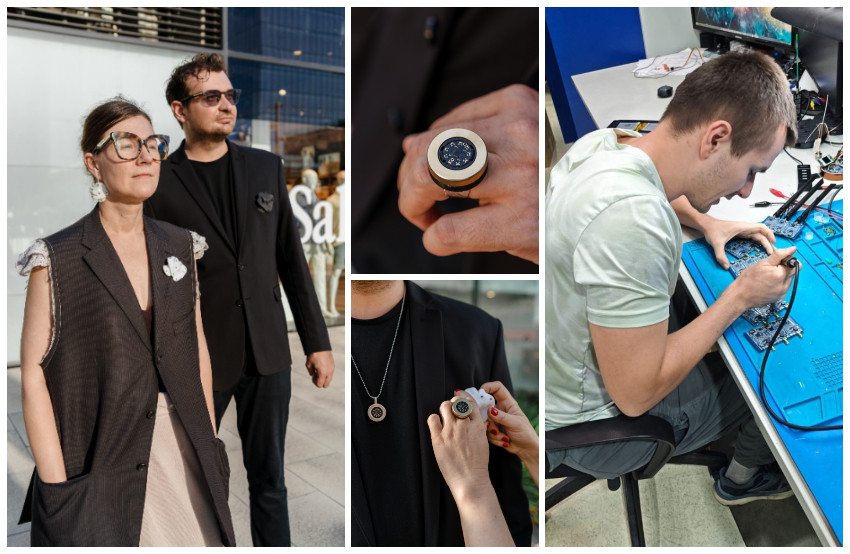
We pushed this philosophy even further in The Vault: here, we combined silver, polymer, and a real electronic chip. We deliberately chose a restrained, minimalist design because the true value of the object is stored inside on the chip, rather than being expressed through external luxury or the cost of the physical materials.
The creative process: how an idea becomes a jewel
My creative process is virtually continuous. I work in my studio six days a week, starting around 8 AM. Ideas come constantly - on a morning run, at a shop, or while sorting through gemstones at my workbench.
The birth of a new piece always begins with classic jewelry alchemy: melting silver, shaping it, soldering components, fitting the stones, and hand-finishing the surface. The hardest part is executing a complex engineering concept when standard bench tools aren't enough, requiring me to improvise or involve specialized collaborators. The most beautiful and moving moment is when dark, raw metal transforms into a finished masterpiece that then finds its true collector.
The evolution of jewelry design in recent years
One of the most interesting changes we see is that the boundaries between disciplines are gradually disappearing. Jewelry, industrial design, digital fabrication, electronics and software no longer have to exist as separate worlds. For us, technology is becoming another material available to the creator, alongside metal, stone, glass or ceramics.
What interests us is not technology that announces itself as technology. Adding a screen, a chip or a digital function to an object does not automatically make it innovative. The more interesting stage begins when technology becomes almost invisible and simply expands what a physical object can be and what it can mean to its owner. This is why we do not see the integration of technology into jewelry as a temporary trend. It feels inevitable. But the challenge is to make technology serve the meaning of the object rather than replace it.
Your latest collection, "The Vāult"
The idea for The Vault came from a very personal experience. During the year following the release of our previous 3D-printed collection, CLOUDS, my apartment was burglarized. A number of valuable pieces of jewelry were stolen. But pieces from Clouds were left behind. Perhaps they did not look like conventional valuables. They were not made to communicate their value through precious stones, gold or recognizable signs of luxury. Yet to me, they were among the most valuable objects in the apartment because they contained something that could not be measured by their material price: our work, our ideas and our history.
That experience changed the question for us. We began thinking about where the value of an object actually lives, and whether the most precious part of a piece of jewelry necessarily has to be visible from the outside.
We found an unexpected connection with an old idea from Jewish tradition: that blessing is found in what is hidden from the eye. We did not want to illustrate this literally, but the thought resonated strongly with us. Perhaps something truly valuable does not always need to announce its value.
This became one of the philosophical foundations of The Vault.
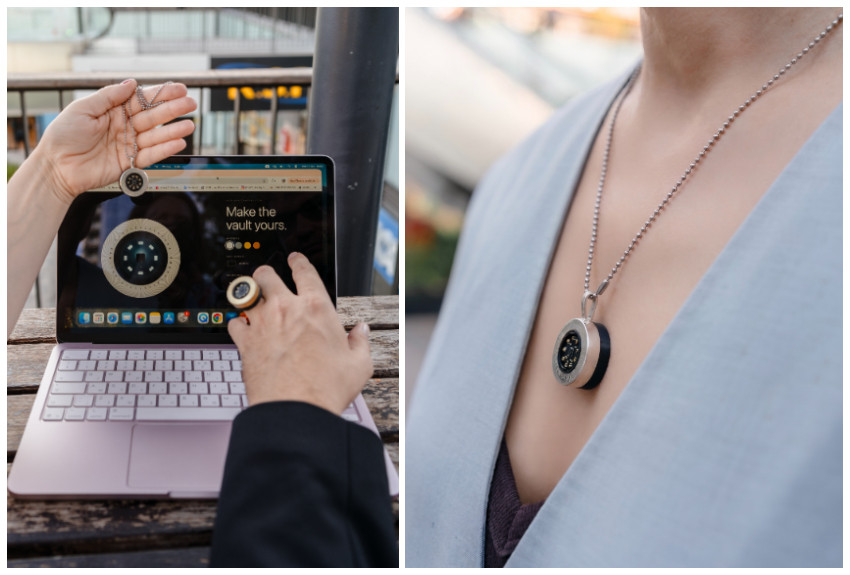
From the outside, the object is deliberately restrained. It does not try to communicate its value through an obvious precious stone or extravagant decoration. Its real “jewel” is hidden inside.
And in our case, that jewel is electronic.
At the center of The Vault is a processor and electronic system capable of holding something private and valuable to its owner: information, identity, memories or secrets. Its value therefore exists in the relationship between the physical object, the technology inside it and the person who owns it. Someone looking at it from the outside does not need to know what it contains. The owner does.
This idea also determined how the project had to be created. The Vault could not be designed by a jeweler first and engineered afterwards. Elena Dobrovolsky, engineer and product designer Alex Dalevich, and electronics engineer Alexey Serbinov had to develop it together.
Jewelry, mechanical construction, electronics, software and digital fabrication therefore became parts of the same design process. We went through physical prototypes, different mechanisms, internal layouts and manufacturing solutions, constantly moving between aesthetics and engineering.
For us, this collaboration became as important as the object itself. The Vault is an experiment in what can happen when jewelry and technology stop being separate disciplines.
Your presence at Romanian Jewelry Week
Romanian Jewelry Week has become something more meaningful to us than simply a place where we exhibit our work. We first participated with CLOUDS, our 3D-printed collection. That experience showed us that ROJW is a space where unconventional ideas are not treated as something peripheral to jewelry. Experimentation, new materials, new production methods and unusual interpretations of what jewelry can be are genuinely welcomed here.
That makes it particularly important for us. When you work at the intersection of jewelry, engineering and technology, you need a place where you can put an experimental object in front of real people and discover whether the idea actually communicates.
At Romanian Jewelry Week we receive that feedback from both sides: from professionals who understand contemporary jewelry deeply, and from visitors who come because they genuinely care about jewelry, design and culture.
For us, this creates a kind of living laboratory. We can experiment, present something that may not fit comfortably into an existing category, and then see how people interact with it, what they understand immediately, what surprises them and what questions it creates.
After our experience with CLOUDS, coming back with The Vault feels like continuing the same conversation, but taking it one step further.
This time we are not only experimenting with how jewelry is manufactured. We are asking what jewelry itself can become.
The creative community here
In the local community, we are most curious to discover the intersections between art, fashion, and technology. As a multidisciplinary jewelry-engineering team, it is vital for us to see how the local scene responds to the wearable tech trend. Above all, we want to learn what new meanings and narratives local creators are embedding into jewelry today and how open they are to joint international experiments at the cross-section of disciplines.