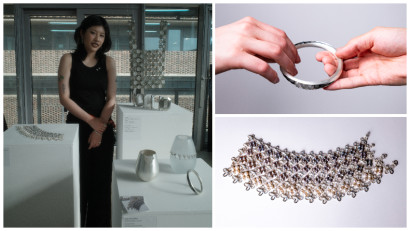

For Chuhan Xiao, jewelry is a space where memory can take shape. A London-based jewelry designer and a graduate of Central Saint Martins and the Royal College of Art, she explores the relationship between the object, the body and the experiences we carry within us. In her practice, jewelry comes close to intimate sculpture, while materials, textures and handcrafted techniques become a way of turning things that are hard to grasp, such as memory, emotion or sensation, into physical objects.
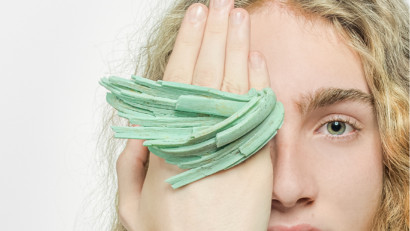
Echoes in the Blur, the collection she brings to Romanian Jewelry Week, starts from the idea of memory as a fluid process, one that can fade, distort and rebuild itself over time.
"I believe memory is never completely fixed. With time, it can blur, distort, and even reconstruct itself, becoming a mixture of truth and fiction shaped by emotion and experience. I wanted to explore this through fragmented layers, blurred textures and shifting forms", says Xiao.
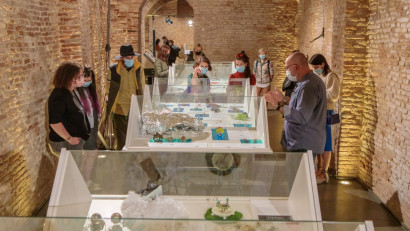
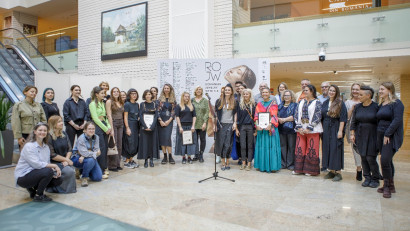
We spoke with Chuhan Xiao about her earliest memories of jewelry, the relationship between the body and the object, and what happens when a personal memory becomes a form that someone else can experience. Chuhan Xiao is taking part in Romanian Jewelry Week, held from 30 September to 4 October 2026 at the National Library of Romania in Bucharest.
How your relationship jewelry begun
Growing up, one of my strongest memories of summer was the smell of magnolia and gardenia flowers. I remember magnolia flowers attached to pieces of wire that could be hooked onto a button, and little bracelets made by threading gardenia flowers together. I would wear them on my clothes or around my wrist, and at the time, they were jewellery to me.
What stayed with me was not really the objects themselves, but the experience of wearing them — the scent so close to the body, and the way it became connected to a particular season, a place, and a moment in my childhood. Looking back, I think this may be where my fascination with jewellery began: not with precious materials or decoration, but with the idea that something worn on the body can carry a memory.
At the same time, I was always someone who enjoyed making things with my hands. So I think I knew quite early on that I wanted to become an artist or a maker. What I didn’t know was what form that would take.
As I grew older, I explored different ways of making and gradually became more interested in the relationship between objects and the body. Jewellery felt like a natural place for me because it sits in such an intimate space between the object and the person wearing it. It can be small and personal, but at the same time it can carry memory, emotion and a sense of identity.
So, in a way, my journey into jewellery was not a single moment when I decided, “I want to be a jewellery designer.” It was more of a gradual discovery — from making things with my hands, to becoming interested in the body, materials and memory, and eventually finding jewellery as the medium through which I could bring these interests together.
What is important to you now in your work
My perspective has definitely evolved over time. Earlier in my practice, I was more interested in playful structures, forms and the physical possibilities of jewellery — exploring what an object could become and how it could interact with the body.
More recently, I’ve become much more interested in memory and sensory experience. I’m drawn to things that are less tangible — such as smell, touch, emotion and the traces that experiences leave behind. I’m interested in how these sensations can be translated into material and form.
Your practice, that shifts jewelry from ornament into wearable art
As part of my current practice, I continue to create both decorative objects and wearable art alongside each other. I don’t necessarily see them as separate practices, but rather as two ways of exploring the same ideas.
I find that decorative objects give me more freedom to develop and express an idea in a more expansive way. Without the physical constraints of the body, I can focus more freely on form, material, scale and concept, and allow an idea to exist purely as an object.
Wearable art, on the other hand, feels much more intimate and personal. Once a piece is worn, it becomes part of the wearer’s body and experience. It moves with them, comes into contact with the skin, and can be felt physically as well as emotionally. For me, the body is not a limitation, but another material that becomes part of the work.
I see the relationship between my objects and jewellery as a natural progression. An idea might first develop through an object-based work, where I can explore its form, materiality or concept more freely, and then I begin to think about how that idea might come closer to the body. Translating it into a wearable form changes the nature of the work — something that was initially observed as an object can become something that is physically experienced.
Personal mark in jewelry creation
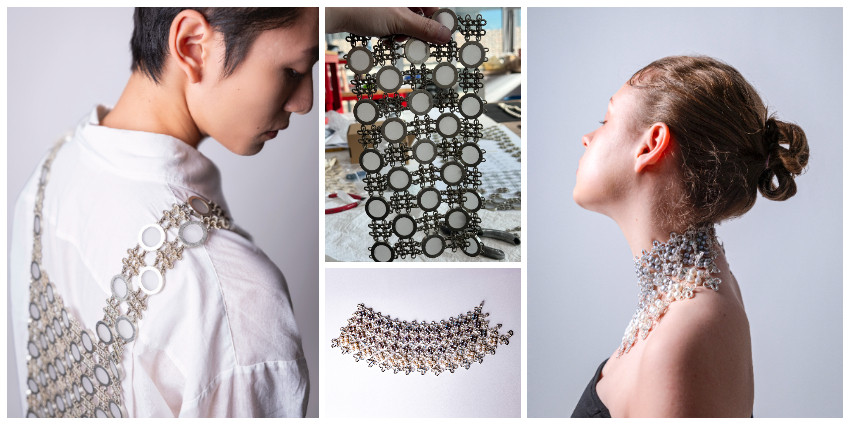
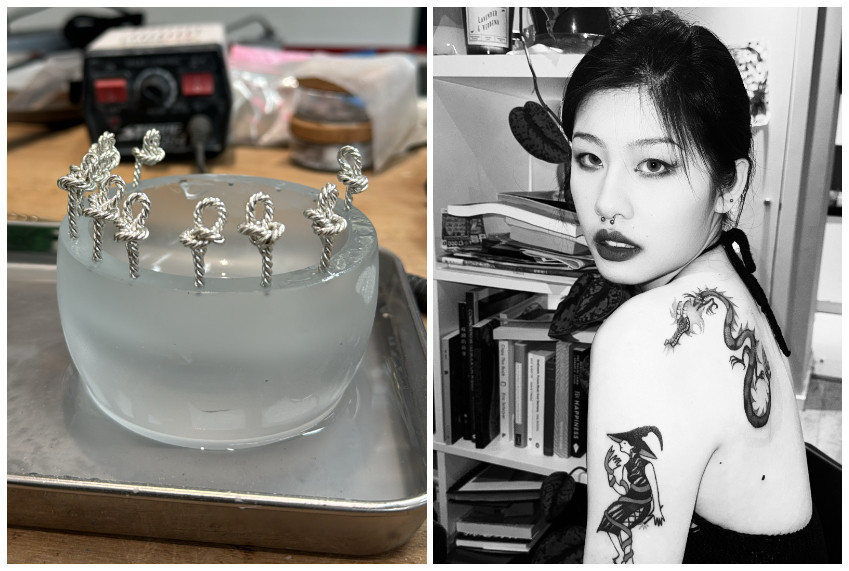
I think my personal mark lies in the way I translate soft, tactile and textile-like forms into jewellery and objects. I’ve been particularly interested in knitted and knot patterns, and in how these delicate, handmade structures can be transformed through materials such as silver. There is something interesting to me about the contrast between the softness suggested by the pattern and the permanence and weight of metal.
My current practice continues to explore this relationship through both vessels and jewellery. Recently, I have created a small series of vessels incorporating tatting patterns cast in silver and mounted onto the surfaces of the vessels. I’m interested in how the pattern can move between being something decorative and something structural, and how it changes when it is taken out of its original textile context and translated into metal. Alongside the vessels, I’m also developing a new jewellery series as an extension of my collection Echoes in the Blur. I’m continuing to work primarily with sterling silver, together with quartz.
The creative process: how an idea becomes a piece
My creative process usually starts with a personal memory, experience, or feeling. I’m interested in how memories can be blurry, fragmented and constantly changing, so I explore different materials and handmade techniques to give these intangible experiences a physical form.
In Echoes in the Blur, for example, I use crochet, weaving and layering to reflect how memories accumulate and intertwine over time. As the work develops, I also think about its relationship with the body and how it can move between jewellery and sculpture.
The hardest part is probably knowing when to stop, to finding the balance between adding something and leaving space for the work to breathe. The most beautiful part is when the material surprises me, and the piece begins to develop in a direction I hadn’t originally imagined.
Your approach in design: the combination between styles and techniques
The connection between traditional craft and the conceptual side of my work developed quite naturally from the way I think about memory. I see each memory as an individual fragment, but over time these fragments accumulate and become intertwined, much like weaving, knotting or beading.
The repetitive nature of these techniques became important to me. Each stitch, knot or bead can represent an individual memory, while the connections between them suggest how memories are linked and reconstructed over time.
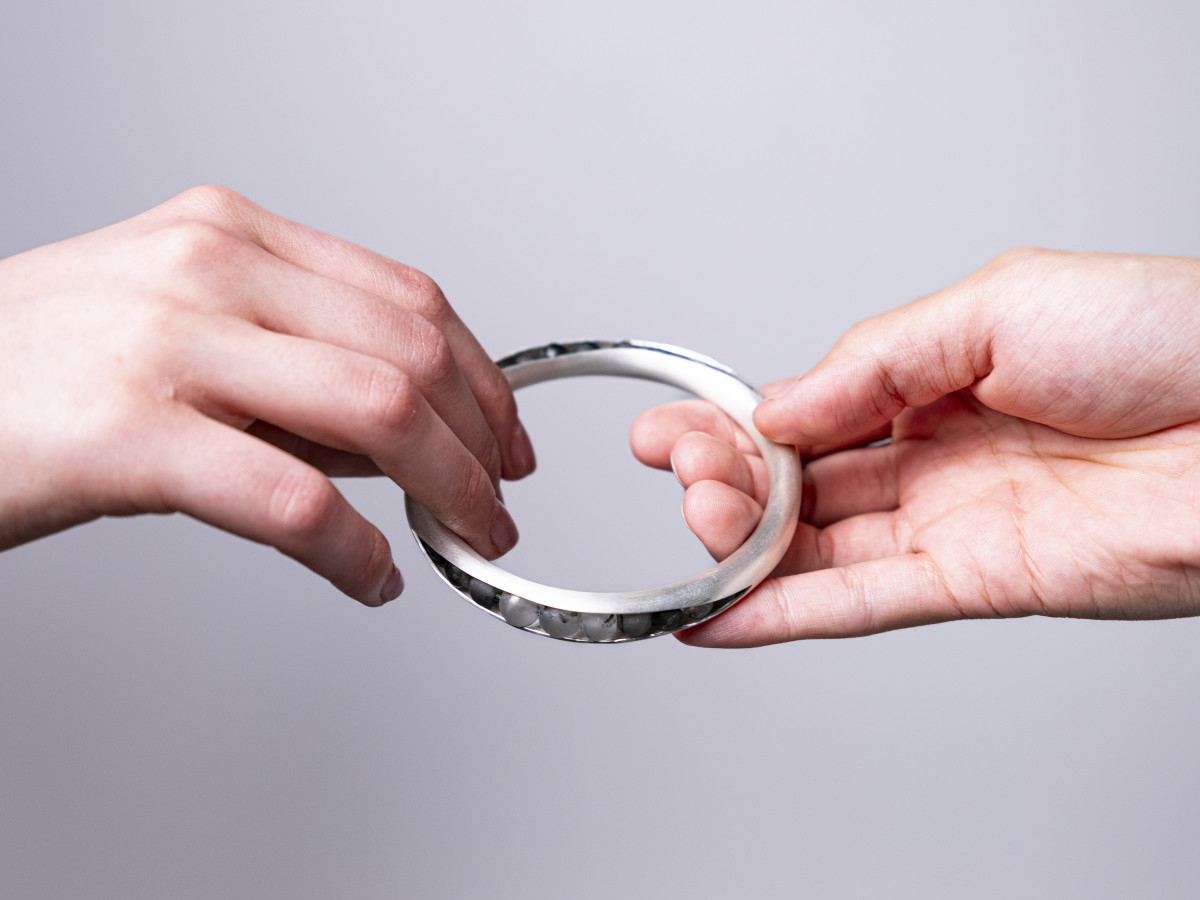
I also became interested in translating these traditionally soft and tactile processes into silver. Knot casting, beading and layering allow me to create structures that feel both delicate and rigid, which reflects the dual nature of memory — something that can be fragile and easily distorted, but also surprisingly resilient.
More about you collection "Echoes in the Blur"
Echoes in the Blur began with my understanding of memory as something fluid and constantly changing. I believe memory is never completely fixed. With time, it can blur, distort, and even reconstruct itself, becoming a mixture of truth and fiction shaped by emotion and experience.
I wanted to explore this through fragmented layers, blurred textures and shifting forms. The collection uses vessels as a central medium — objects that hold and contain things. For me, they become a metaphor for how we store and carry memories, but also how memories are passed on and transformed over time.
I think of memories as individual fragments that gradually accumulate and intertwine, much like threads, stitches or beads coming together to form a larger structure. This led me to explore different scales and dimensions, from flat surfaces to three-dimensional forms and pieces that shift between the two.
Through the collection, I want to suggest that memory is both fragile and resilient. It can be distorted or fragmented, but these fragments continue to shape who we are. Rather than presenting memory as something fixed, I hope the work invites people to think about their own memories and how they have changed over time.
What you feel young designers, fresh out of school, bring into a scene of jewelry design
I think young designers bring a sense of openness and a willingness to question what already exists. Coming straight out of school, we’re still exploring, experimenting and figuring out our own language, so there is often less pressure to follow established conventions.
For me, being part of a new generation also means being open to crossing boundaries — between art, jewelry, craft and design, for example. I think that freedom to experiment can bring new perspectives and new ways of thinking about what jewelry can be.
At the same time, I’m still learning, and I see that as a strength. Not having all the answers leaves room for curiosity, experimentation and discovery.
The jewelry scene in London, especially around Central Saint Martins and the Royal College of Art
I think London has a very open and diverse jewelry scene, especially for young and independent makers. There is a strong culture of experimentation, and I find that jewelry often overlaps with art, fashion, craft and design rather than existing within one fixed category. Being surrounded by people working across these different disciplines has encouraged me to think more freely about what jewelry can be.
When I started my bachelor’s degree at Central Saint Martins, I began exploring the relationships between material, the body, jewelry and art. It gave me a foundation for thinking beyond jewelry as an accessory and encouraged me to consider how materials and objects can communicate ideas and experiences.
At the Royal College of Art, I developed this exploration further. The Jewelry and Metal Program gave me the opportunity to work more extensively with objects as well as wearable pieces, which broadened my understanding of how jewelry can exist beyond the body.
Looking back, both experiences have shaped my approach today. I see jewelry less as an accessory and more as a medium that can move between ornament, object and intimate sculpture.
Your participation at Romanian Jewelry Week this year
I was drawn to Romanian Jewelry Week because it offers an opportunity to step outside the environment I’ve been working in and connect with a different jewellery community. At this stage of my career, I’m particularly interested in meeting other designers, seeing how they approach materials and ideas, and exchanging perspectives.
I’m also curious to discover the local creative scene and how jewellery is understood and practised in Romania. I think every place has its own cultural references, craft traditions and ways of thinking about the body and objects, and I’m interested in seeing how these influence contemporary jewellery here.
More than anything, I hope to leave with new conversations, new references and perhaps some unexpected connections that might influence where my practice goes next.
How you feel that your work is seen by a different, international audience
For me, having my work seen by an international audience is an exciting opportunity to see how people from different backgrounds respond to it. My work is often rooted in personal memory, but I’m interested in the fact that memory is something everyone experiences in very different ways.
I find it more interesting when people bring their own experiences and associations to my works. At this stage of my career, being able to share my work internationally gives me the opportunity to open up those conversations, receive new perspectives, and understand how my work can communicate beyond the context in which it was originally made.
It also feels like an important step in developing my practice — not only having the work seen, but listening to how different audiences experience it.