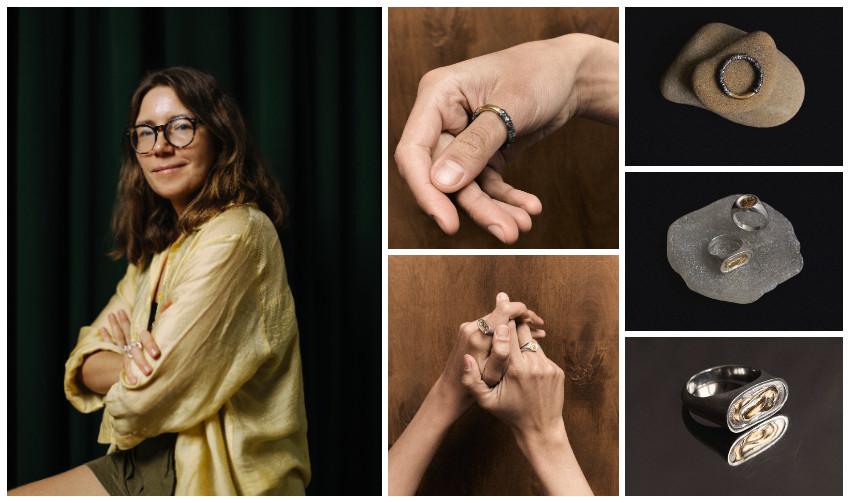
Svitlana Lohvynenko and her husband, Vadym, were looking for a creative practice they could share and build into something lasting. Ideally, they hoped it would become a passion they could one day pass on to their children.
Ten years later, Logvin has become a recognized name in the world of contemporary jewelry, featured in international exhibitions and connected to creative communities across several European countries. When life became increasingly difficult in their home country, the entire family relocated to Romania, where they were welcomed with open arms by the local contemporary jewelry community.
Born in Kyiv and shaped today by multiple cultural spaces, their project speaks about research, craftsmanship, memory, and curiosity. And throughout this journey, their children have become part of the story as well.
„As a mother of three, I think a lot about the kind of creative world we're leaving to the next generation. If Logvin can become part of building a more open, generous, and connected community, that would probably be the achievement I’m most proud”
We spoke with Svitlana Lohvynenko about her journey from project management to contemporary jewelry, about the ten-year process of building the Logvin brand, about the community that welcomed her family to Romania as they were rebuilding their lives, and about the way a piece of jewelry can, over time, become part of the story of the person who wears it.
The path that brought you to the world of contemporary jewelry
I've always enjoyed building projects that bring people, ideas, and creativity together. Alongside Logvin, project management has always been part of my life. I studied it, and over the years I've continued working on projects that connect creative people, disciplines, and communities.
Contemporary jewelry became the right medium because it naturally brings together craftsmanship, design, ideas, and personal stories. What fascinates me most is that a piece of jewelry can become much more than an object—it can stay with someone for years and quietly become part of their own story.
Today my role is to shape the vision, partnerships, and communication around Logvin, while Vadym gives ideas their physical form. Together, that's how our work evolves.
How the brand appeared
Logvin grew from a very personal search. My husband and I wanted to build one creative practice we could dedicate our lives to together—something that would keep evolving with us and hopefully one day become part of our children's story as well. This year we celebrate ten years of that journey.
We weren't looking specifically to start a jewelry brand. We were looking for a shared creative practice—something we could dedicate our lives to, keep exploring for years, and one day pass on to our children. It may sound romantic, but that's honestly how it began.
Over time, Logvin has evolved into an experimental studio, giving us the freedom to explore while balancing artistic curiosity with the realities of building an independent brand. Today, our children are naturally becoming part of that journey too. This year we celebrate ten years of building Logvin. Looking back, I think that's why we still describe Logvin as a family project.
The moment you realized the jewelry making became more than a creative passion
I remember creating our very first Instagram page. It felt surprisingly significant; we were introducing ourselves to the world for the first time. We had just launched a geometric collection inspired by the story of the black and white swan. Looking back, I realize that even then we weren't simply making jewelry—we were already trying to express ideas and personal experiences through it. Around the same time, together with our first brilliant social media manager, we reached our first thousand followers, orders started coming in, I built our first website, and fashion magazines began noticing our work.
That was the moment I realized this was no longer just a creative passion. We were building something with its own voice, community, and future.
The lessons, challenges and turning points in your development as jewelry designers
Collaborating with the National Museum of the History of Ukraine on the Treasure collection was one of the defining moments in our development. Working with historical artifacts taught us that jewelry can become a bridge between cultural heritage and contemporary design.
Another defining moment was presenting our work at the Lisbon Jewelry Biennial, where political jewelry became a way to speak about personal experience, cultural memory, and the realities of war. Both experiences came with a different kind of responsibility and challenged us to think more deeply about the role jewelry can play in society and culture.
Looking back, I think the biggest lesson has been learning to stay curious while becoming more confident in our own voice.
From Kiev to Romania
Our roots will always remain in Kyiv—it is where Logvin was born and where our values first took shape. Moving to Romania introduced us to an incredibly open contemporary jewelry community. Its generosity, curiosity, and willingness to share knowledge changed us profoundly.
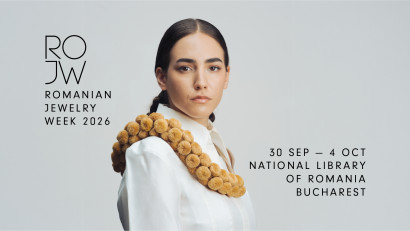
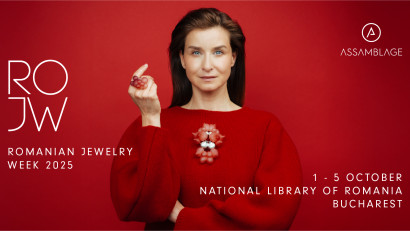
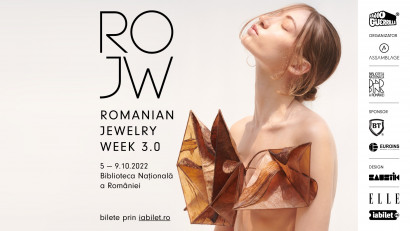
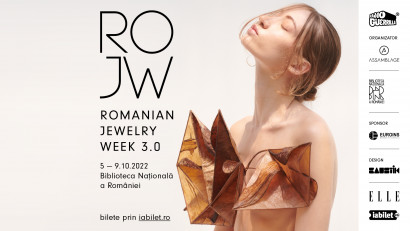
We are especially grateful to David Sandu, founder of Assemblage Contemporary Jewelry School and co-founder of Romanian Jewelry Week, and to Dan Pierșinaru, founder of AUTOR.
They welcomed us at a time when we were rebuilding our lives and, in many ways, opened the door to the international contemporary jewelry world. From there, our journey naturally expanded through international exhibitions, collaborations, and learning opportunities.
For Vadym, studying with masters such as Peter Bauhuis and Georg Dobler reshaped the way he thinks about materials and craftsmanship. For me, it meant learning to think internationally—to see grants, residencies, and collaborations not as something distant, but as opportunities within reach.
More than anything, this experience taught us that creative practice grows through people. The community we found gave us confidence, inspiration, and a sense of belonging. Today, we hope to contribute to it with the same openness we were welcomed with.
Your visual language
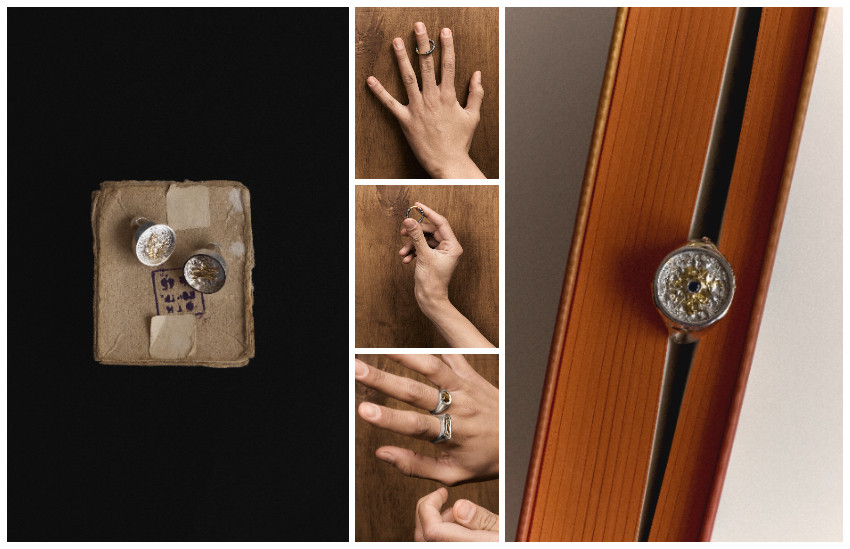
We’re drawn to surfaces that tell the truth about how they came to be. We don't try to erase the traces of making because they become part of the piece itself. Many of our collections begin with curiosity. Vadym has an endless curiosity about metal itself— its history, forgotten techniques, ancient alloys, and traditional craftsmanship. Research, museum collections, and material experiments often become the starting point for our work, long before a collection has a name. Honestly, I think he'd happily disappear into the workshop exploring metal and its possibilities if there weren't always practical things that also needed his attention.
Rather than pursuing perfection, we're interested in creating jewelry that feels honest, tactile, and alive.
The subjects, feelings or questions that keep returning to your work
We rarely begin with a trend or even with a specific object. Most of our collections begin with a question we are trying to understand ourselves. Again and again, we return to the same themes: how people change through experience, how we let go of old beliefs, how we find the strength to begin again, and how important it is to celebrate life despite its fragility.
The jewelry isn't meant to provide answers. We hope it creates space for reflection and allows each person to discover their own meaning in the piece.
We don't consciously try to place our work within one category. What matters to us is creating pieces that carry an artistic idea while remaining part of everyday life.
A piece or collection that tells a story you could not have expressed in any other way
Probably the next chapter of our Illusions collection, which we are preparing to launch this autumn. In these new pieces, we set diamonds into fractured surfaces. My mother loves to jokingly remind me that diamonds are formed under pressure, always hinting that I still have every chance of becoming one.
For me, those diamonds represent the values we discover only after life's challenges—the beliefs and inner strength that emerge once we've been tested. They don't hide the cracks; they celebrate what emerged through them. I don't think I could express that through another medium. Jewelry is precious in the most literal sense, and that's exactly why it matters. It becomes a quiet reminder of the values you choose to carry with you.
What people seek when they choose a piece from Logvin
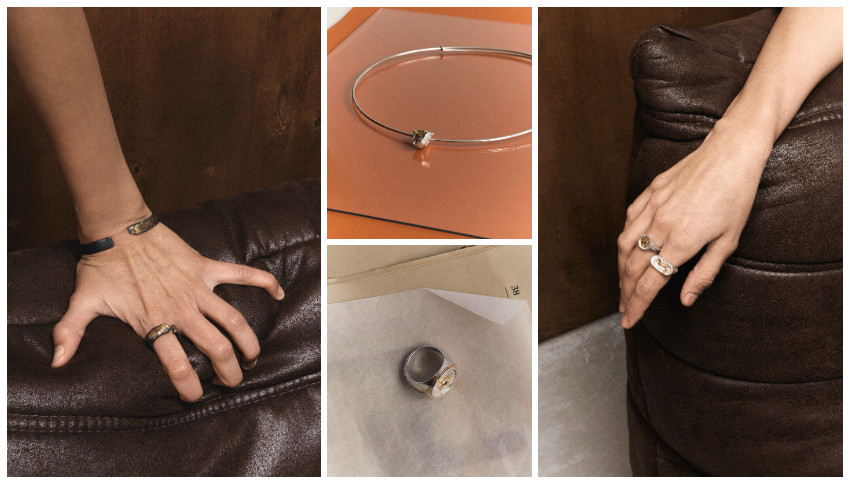
The people who choose Logvin don't usually wear jewelry to express something to the world. They wear it to stay connected to something within themselves, allowing each piece to quietly become part of their own story.
Your creative process
Our process is rarely linear. Vadym usually has a growing archive of material experiments, prototypes, and technical discoveries. Some of them wait for months, even years, before they find their place. When one of those ideas suddenly feels right for the current context, we begin developing it into a collection. From that point, everything usually comes together quite
The hardest part is recognizing when an idea is ready. We often have several evolving at the same time, each at a different stage. We've learned not to force them before they feel complete. And, of course, not every experiment becomes a collection. We have boxes full of one-off prototypes and unexpected pieces that never found their narrative. Sometimes they end up finding their owners at markets or at Assemblage and we actually love that they get to have a life of their own.
How your perspective on contemporary jewelry changed after participating in international exhibitions
International exhibitions made us realize that there isn't one way to make contemporary jewelry. Every artist brings their own cultural background, questions, and visual language. Instead of making us want to fit in, those experiences gave us the confidence to trust our own voice even more.
What surprised you most to the contemporary jewelry scene in Romania
What impresses me most is the scale and the impact. The Romanian contemporary jewelry scene is still relatively small and operates with very limited resources. Behind the scenes, an enormous amount is achieved through the dedication of a few people rather than large institutional support.
What makes it unique is that it creates opportunities. For many emerging artists, Romanian Jewelry Week or AUTOR become the first place where they can exhibit internationally, receive professional feedback, and build relationships with curators, collectors, and other artists. That experience can completely change the way you see your own work.
I've seen this happen not only with Romanian artists but also with Ukrainian jewelers. I personally helped several of them prepare their portfolios for open calls, and those opportunities became an important step in their professional development. Looking at the community today compared to just a few years ago, the growth is remarkable.
How you see contemporary jewelry evolving today
I believe contemporary jewelry is particularly well positioned for the future because it naturally aligns with the way consumer values are evolving. We're seeing a clear shift towards conscious consumption—people are buying fewer objects, but expecting greater authenticity, longevity, and emotional value from each purchase.
Consumers are increasingly interested in craftsmanship, recycled precious metals, transparent production, traceability, local making, limited editions, and knowing the person behind the work.
They're not only buying an object anymore, they're choosing a story, a set of values, and a creative voice.
In a world shaped by overproduction, automation, and AI, I believe the value of human craftsmanship and artistic authorship will only continue to grow.
What excites you most about the future of Logvin Jewelry
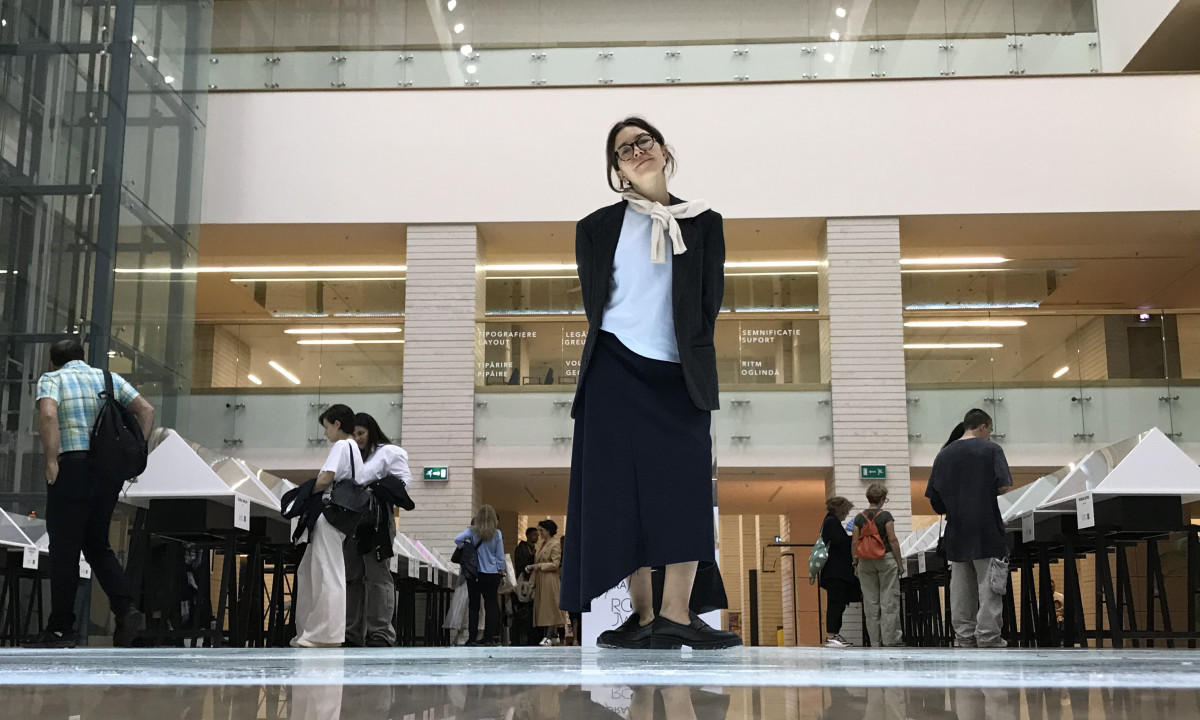
For many years, our focus was on building the brand step by step and adapting to constant change. Today, for the first time, I feel we have the confidence to think beyond ourselves. Of course, I'm excited about new collections and seeing the brand continue to grow. But what inspires me even more is the possibility of contributing to a stronger creative ecosystem - bringing together artists, institutions, education, and international collaborations.
As a mother of three, I think a lot about the kind of creative world we're leaving to the next generation. If Logvin can become part of building a more open, generous, and connected community, that would probably be the achievement I’m most proud.