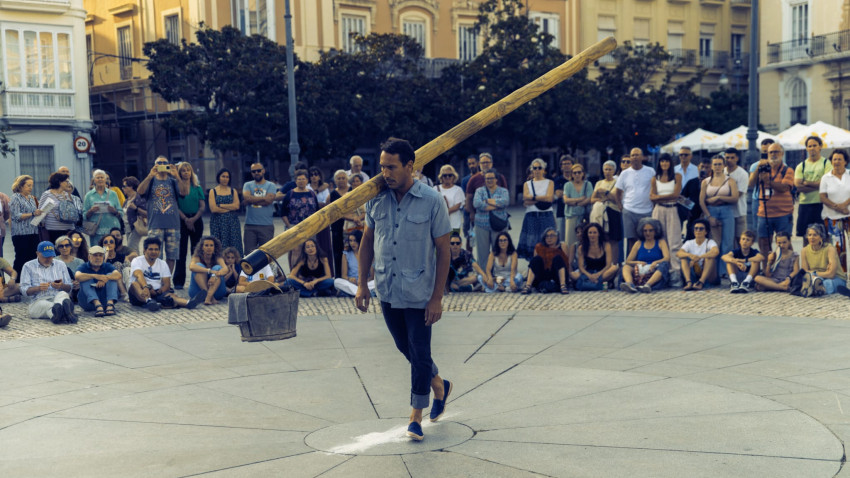
Freedom, play, acrobatics, humour, craftsmanship. Or: how to make the burden of life a little lighter. Joan Català Carrasco’s creations emerge from fragile balances: people meeting people, and the flow of emotions between them. It is hard to imagine that they are rooted in an apprenticeship in a blacksmith’s workshop. And yet, that is exactly where it all began.
Joan was born in Barcelona in 1978. He studied visual arts at La Llotja School of Applied Arts and Artistic Crafts from 1994. He trained at several circus schools, including Carampa in Madrid, Rogelio Rivel in Barcelona and the National Circus School in Moscow, specializing in hand-to-hand acrobatics. Alongside this, he also trained in contemporary dance, physical theatre and clowning. In 2012, he began developing his own vision of performance for public spaces and urban landscapes with the creation of Pelat.
"I use unusual objects, often very large and very heavy. They are also usually objects that nobody has used before in the way that I use them. The beginnings of my relationships with different objects are very stimulating. Then I go through a phase of physical pain where the same question always appears: "Why did I choose this shitty object that is destroying my body?", says Joan.
Pelat is coming to the Sibiu International Theatre Festival this year. FITS takes place from June 19 to June 28, and the theme of this year's edition is "Soul". We continue our conversation with Joan Català Carrasco about people, streets, emotion and community.
To blur the line between play, art and sport
I think that people who dedicate themselves to this profession each arrive here for different reasons: a series of events, life experiences, and decisions that make us understand it, at first, from a certain place. Little by little, we transform it, question it, and accept who we are as life changes — and therefore as we ourselves change. And sometimes we are capable of bringing that onto the stage. And if we don't bring it onto the stage, at the very least it helps us search for the paths that lead us there.
I think that from the very beginning, when I started studying performing arts — specifically at circus schools — I did so because of its proximity to sport. Since I was a child, I had a natural ability for certain sports (athletics, swimming, trial biking), which in some way shared similarities with certain circus disciplines. The explosiveness and control of the body that athletics requires could be applied to acrobatics and its variations. Trial biking was directly related to balancing on objects, something that is used extensively in circus arts.
I also studied at schools and institutes of visual arts, where I came closer to Art and began to take an interest in it — more from a graphic, visual, and sculptural perspective, a viewpoint closer to the fine arts.
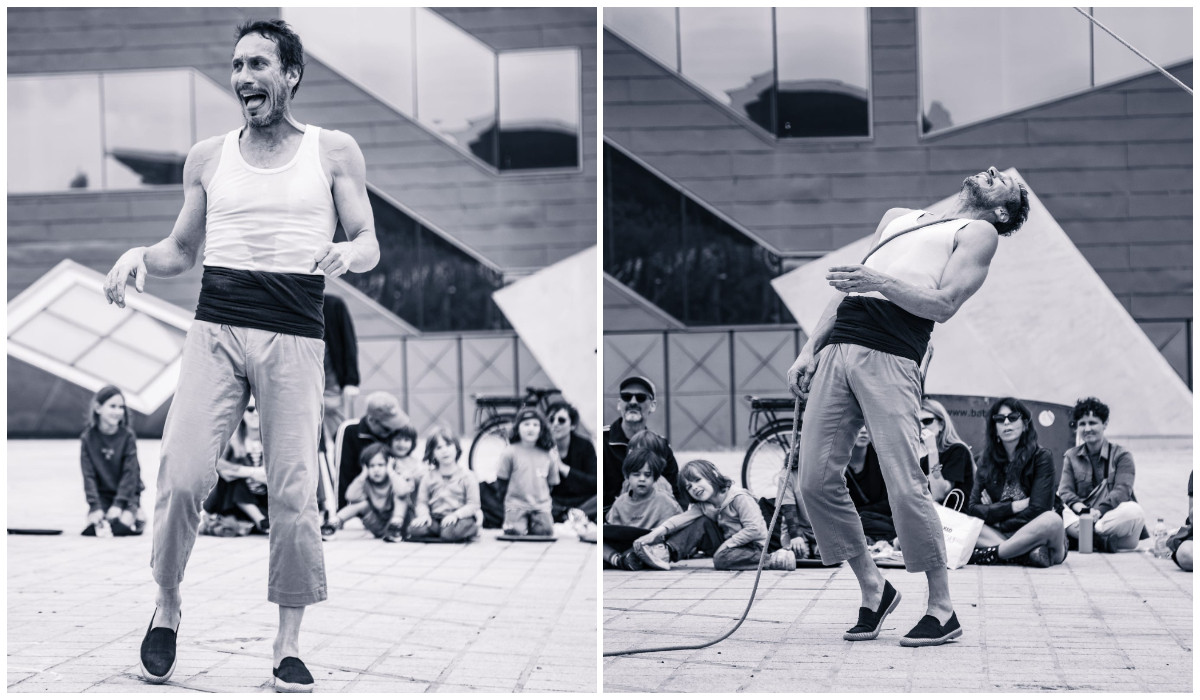
Photo credit: @leonardogregoretfotografia
Becoming a performer
The first time I remember was when I saw a street performance (Amalgama) by the circus company Los Galindos. I was 19 years old and, seeing that outpouring of freedom, delirium, fantasy, playfulness, and emotion, I felt that I wanted to do that. To live that firsthand. To fly!
It also coincided with the time when I left my parents' house, where the relationship had become very, very tense... and I felt that this was the path I needed to explore. Today I am grateful to that 19-year-old who had the courage to explore the world beyond the imposed borders.
Your artistic language
For several years I worked with different circus, theatre, and contemporary dance companies. During those years I was always a performer serving a director and their way of working and imagining.
After some years, and while gradually building my own character and my own opinions about the performing arts, I started finding the areas that interested me most to develop. I discovered that they had less to do with artistic disciplines such as dance, physical theatre, clowning, or any circus discipline, and much more to do with approaching my work from the idea of stage craftsmanship.
My past is completely influenced by the workshop work of a metalworker-blacksmith. I come from a family of four generations of blacksmiths and metalworkers. From a very young age, I was obliged to work in the family workshop. Building, cutting, welding, sanding, and exploring the different possibilities of iron.
During the years I spent there, I never felt a special connection with that trade. But over time I began to appreciate all that knowledge, which I learned by obligation but which today helps me in EVERYTHING I imagine.
The way I relate to materials when I am searching or researching for a new show. The way I relate to people on stage and don't hide the tougher side of my character, allowing it to intertwine with the vulnerable and fragile side of who I am...
With all this, what I mean is that perhaps the discipline that has influenced my artistic language the most is those years in the workshop, where beauty appears little by little and through hammer blows.
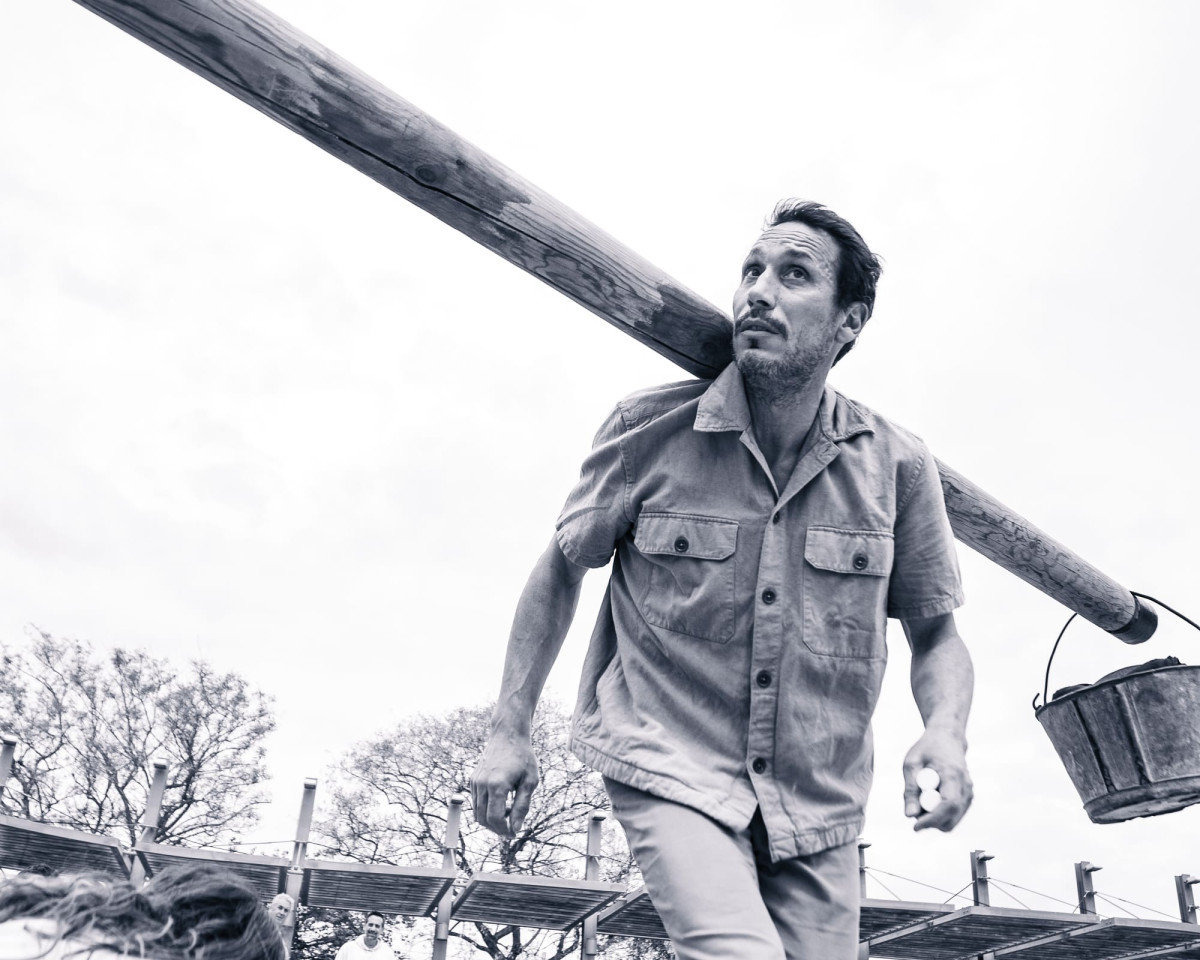
Photo credit: @leonardogregoretfotografia
Changes in the way you create
Fortunately, many things. Hahahahahahahahaha! What I identify today as the biggest change is how I present myself in front of people, audiences, spectators: I am no longer ashamed to accept the monster that also exists within me.
Obviously, without disrespecting anyone while performing my shows. But I understand that beyond the “character” one chooses for a performance, there is a very powerful residue connected to one's real character and the real emotions that emerge in every moment.
As much as I can, I try to be as truthful as possible, accepting perhaps the less beautiful aspects of my personality. At least during that hour. The rest of the day is another story. Hahahahahahahahaha.
How does a new creation come to life
Each project, each creation, comes from its own unique place. Sometimes it is something carefully thought through beforehand. Sometimes it appears through a “supposed accident.” There are many possible paths.
I think that one of the great magic qualities of this profession is precisely that there are no master formulas guaranteed to work. There is a quote from a writer, philosopher, and architect that I read in his book The Thinking Hand:
“Creative thinking is work, in the full sense of the word, rather than a flash of unexpected insight that emerges effortlessly”, Juhani Pallasmaa
It is true that there must be a lot of trial and error. With scenographic decisions. With physical materials. With the conceptual writing of a piece.
One must be more flexible than rigid.
One must allow pauses in creative processes in order to understand what stays and what goes. What adds to the proposal and what takes away from it. To identify potential and develop it.
Personally, I use many of my own memories as creative triggers. I never use those memories to explain them narratively in my performances. That doesn't interest me. But they do help sustain me as a performer inside my performances.
Perhaps the only truly important thing when creating a show is that it must be born from a real and profound desire.
Never from something imposed.
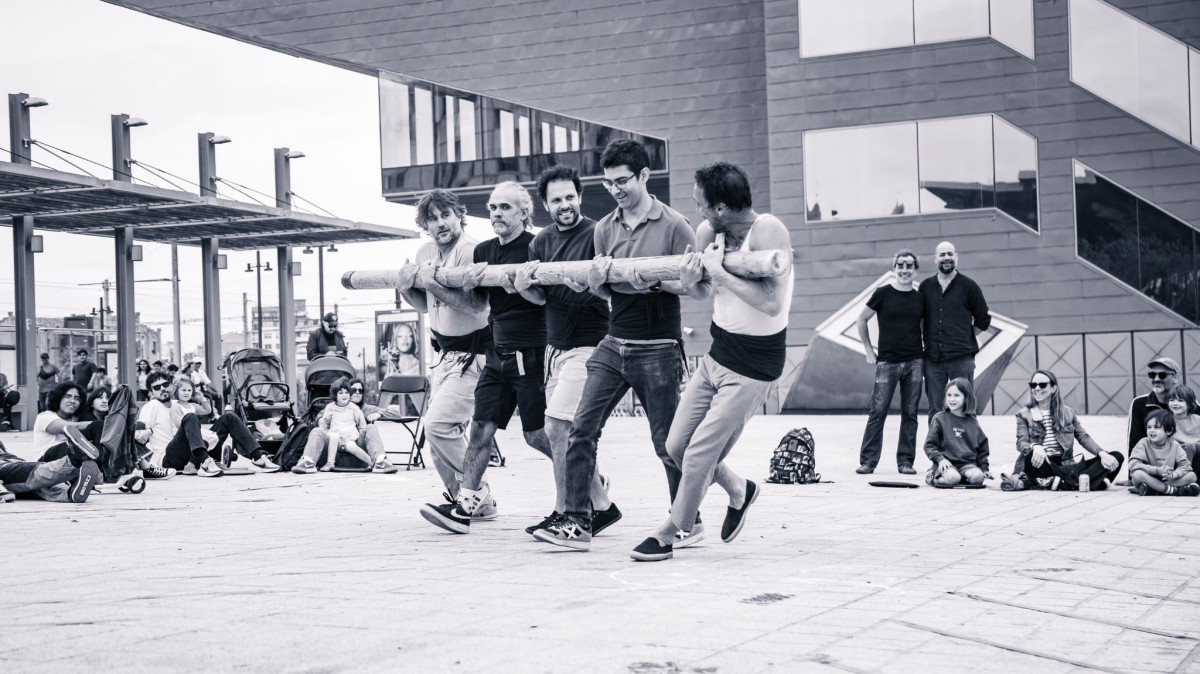
Photo credit: @leonardogregoretfotografia
Your relationship with objects
They are my partners. My companions. I embark on different journeys with them.
In my way of working, I like to imagine that there is a real dialogue between space, performer, and object. Being aware of the identity of each element helps me develop the performances creatively.
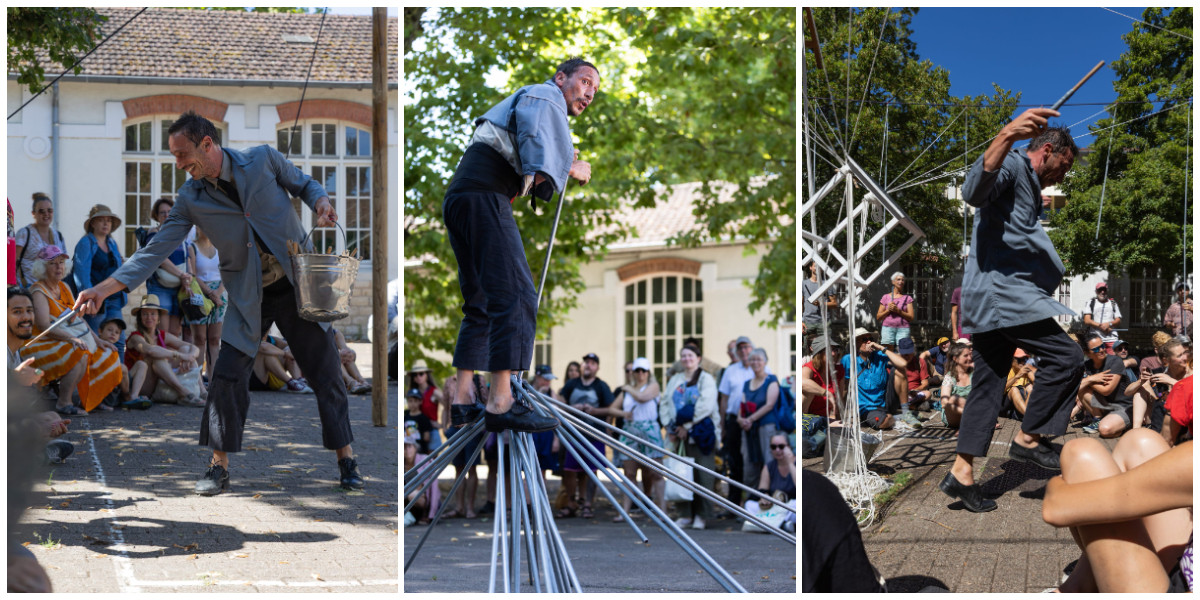
I use unusual objects, often very large and very heavy. They are also usually objects that nobody has used before in the way that I use them. That is why the research process starts from zero.
The beginnings of my relationships with different objects are very stimulating. Then I go through a phase of physical pain where the same question always appears: "Why did I choose this shitty object that is destroying my body?"
And after all that time comes a unique satisfaction — reaching a way of relating to them that I could never have imagined before.
A long and difficult relationship that gradually transforms into something light and full of fantasy.
The biggest challenge performing outdoors
I imagine each person has their own challenges. And I also imagine they change depending on the project you are immersed in. Lately, what happens to me is that I want to be present in everything that happens during the time I am performing. Present in the sense of accepting whatever arrives.
The two shows I currently have on tour take place outdoors, in public space, and they are also performances with active audience participation. So whether I like it or not, I am obliged to dialogue with the audience.
I am obliged to accept being challenged by them. To accept that they may disagree with me. That they may test me. Or that they may follow me blindly.
And, of course, the greatest challenge is getting them to embark on the imaginary world I am offering them.
I like to think in terms of shared responsibility.
I believe that in public space spectators are also responsible for "that thing" that is happening in front of them at that moment.
How has street art changed in recent years
Art itself keeps mutating. That is one of its virtues. Concepts are revisited. Ideas are reinterpreted. Previous ways of working are questioned. Practices of questionable relevance are reconsidered.
In the case of art in public space, I have the feeling that it will always retain an underground and rebellious component. It is something offered and shared generously. And it allows the perspectives of different social classes to intertwine without even being fully aware of it.
I am not sure whether there has really been a change in the way people experience free art in public spaces. I think it actually offers an opportunity to interrupt the speed imposed by phones and social media.
It is a real moment happening before people's eyes, involving real flesh-and-blood human beings breathing together in the same place at the same time.
For me, the most significant change is political and social. For example, in the 1980s and 1990s there were transgressive performances on a gigantic scale that absolutely needed to be that way.
Several societies were emerging from complex political processes, and ordinary people enjoyed those artistic manifestations that truly shook the foundations of society. They were very necessary.
Today there are also struggles that need to be brought to the table. There are creators who feel the responsibility to speak about them. And they should.
What is true is that the spectators who enjoy the different proposals that street art offers also have a personal challenge: To be there. Present. Not to feel the need to check their phone every two minutes. Not to feel the need to upload the moment they are living to social media. Not to record and archive everything their eyes see in a digital file that will never be looked at again or used for anything.
The role of street art in surprising people
Today there are many ways of understanding art in public space.
There is an endless number of audience configurations. Multidisciplinary approaches. Choices of place and space. Collaborations between audiences and performers. Works with social content. Others that are more experiential. Others that are impactful and hermetic. Wandering forms. Countless possibilities.
I have the feeling that years and decades will continue to pass, and audiences will continue to seek the same things.
First, variety and the ability to choose.
And second, another opportunity to experience this convention, this ritual that is theatre, from a place that allows them to fly, think, feel, kill their demons, and ultimately leave with something to tell and share with whomever they wish.
In short, to make hardship lighter.
The story of PELAT
The name of the performance is PELAT. There is a stripped tree trunk (pelat in Catalan), without bark. An empty space, also stripped bare, without scenery.
There is no text.
There is no music.
PELAT began taking shape inside me around 2010–2011. For some time I had been questioning certain theatrical codes used when audiences were invited to collaborate or participate.
For several years, as a spectator, whenever I saw performances that involved audience participation, I did not always agree with the way performers approached it. I felt a certain rejection when I saw how often spectators were ridiculed. That helped me begin developing my own perspective on street performances that involve the audience as collaborators.
I came to understand that responsibility is shared between performer and audience. And that one of the ways I could help people experience it that way was by giving spectators real tasks.
Working together during the performance and making them responsible as well for that unique moment that was about to happen.
I also wanted to share my love for craftsmanship.
For things made by hand.
For their roughness.
For work done without major technological or modern means.
For valuing contemplation and silence.
For appreciating physical labour and effort.
For laughing at myself and at certain forms of masculinity.
For universal humour.
I felt the need to create something that was equally simple and profound.
A kind of ritual in which a single individual begins alone and ends with a human group of hundreds of people vibrating on the same frequency.
A journey from the individual to the collective.
Your rituals
There is a phrase that has accompanied me in recent years and has helped me enormously. It works in every direction. For me, it has become a mantra:
If you compare yourself, you have already lost.
What have you learned about people from performing in the streets
We are unique.
It is true that the type of humour I use is universal, and everyone can understand it. Many of the primary reactions to laughter are very similar, whether in Barcelona, Ivory Coast, Romania, or South Korea.
What does change are certain behavioural, educational, and socio-cultural codes, which are closely linked to the social pulse of each place, country, or city.
I notice it in how people arrive at the place where the show will happen.
How they organize themselves.
How they sit.
How they talk and discuss among themselves before the show.
The volume of their voices.
The glances exchanged between supposed strangers.
So I understand that I must listen to what is happening around me.
To become part of all that as well.
I never forget that I am the outsider.
They are at home.
I am the guest.
I must surprise, not impose.
What has the street taught you
To accept whatever happens and respond from a good place.
To say yes before saying no.
That I have a responsibility because I am privileged enough to dedicate my life to this profession.
That I must share from a place of generosity.
That when I encounter a hostile gaze, I should not assume it is directed at me.
You never know what that person is going through.