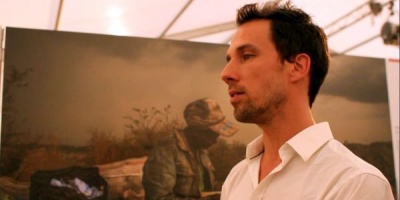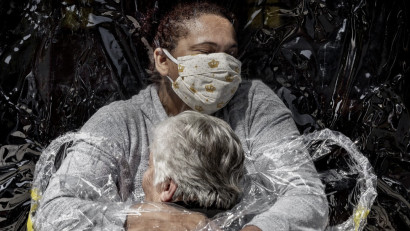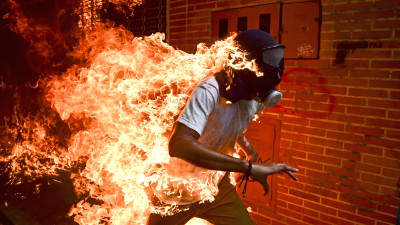

The major themes presented in this year’s World Press Photo exhibition were the war and its victims, climate change, the oppression of women and minority groups. We are facing a major crisis in humanity, things are not going well at all for human species, says photographer Prins de Vos. He also hopes that the selected photos will raise awareness of the current situation and encourage people to take action against war, pollution, women and minority communities abuses.
„These stories contribute to awareness. They honestly and directly reveal what is happening in the world. I can’t speak for every photojournalist, but I believe we all strive to make sure these stories do not go unseen. They reflect the current state of the world”, says Prins de Vos.
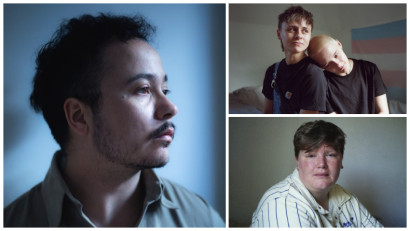
Prins de Vos is a documentary photographer from Amsterdam whose work carries an activist tone. He is among this year’s World Press Photo winners with Mika, a project portraying one of the thousands of trans and non-binary individuals stuck on waiting lists for gender-affirming medical care.
Your background
I’m a documentary photographer from Amsterdam, the Netherlands, where I’ve lived for the past ten years. In 2013, I graduated from the Academy for Pop Culture in Leeuwarden, a relatively small arts school that allows you to graduate in various disciplines, such as music and design. I chose photography and completed my studies with my first photo book, Enclose. For that series, I photographed myself and my then partner. Although I began the series quite innocently, my work quickly developed an activist undertone. Because when you portray queer individuals, you will unfortunately encounter resistance. That experience made me increasingly focus my work on representing the queer and trans community. Since then, I’ve had the opportunity to exhibit in many special places, I published my second photo book BOYS DO CRY in 2022, and this year I received a World Press Photo award as a crowning achievement.
Your beginning in photography
When I was ten, my mother gave me a Polaroid camera for my birthday. I started photographing eagerly, pasting the pictures on my bedroom door until it was completely covered. I found it magical to be able to freeze moments, to immortalize them. That is definitely where the seed was planted.
After the Polaroid, it took a while before I bought a new camera. I remember it vividly: it was 2012 and I was walking through a flea market. I saw an old compact analog camera for just a few euros, and it even had a roll of film inside. I decided to take it home and immediately started photographing my then partner. That became the beginning of my very first photo series Enclose. One year later, the book was published.
Defining moments from your development as a photograph
In the beginning, I had no technical knowledge at all. I just started shooting with that compact camera I mentioned. Over the years, I’ve had two mentors who became important to me: Peter Blok and Jasper Groen, both Dutch photographers. Peter was a friend of my parents. When I was sixteen, he took me to a photography workshop and told me I had a good eye. I’ll never forget that compliment. In the third year of my studies, I interned with Jasper Groen. He taught me everything about photography and introduced me to the work of amazing photographers like Nan Goldin, Bertien van Manen, and Larry Clark. A fun fact: Jasper’s latest photo book ¡Existo! was just released, and I was asked to write the foreword, which was very special for me as his former intern.
How has the perspective on photography changed for you
To me, photography can simply be something to get lost in. It doesn’t always have to serve a purpose. An image that captures your attention for whatever reason can transport you. Still, I fully acknowledge the power photography holds. It’s a powerful medium to shed light on issues and make the invisible visible. It allows us to tell stories. Those two sides can exist simultaneously. For example, next to my activist work, I’m also working on a series called The Contra Project, where I photograph only in nature. I allow myself to make images that don’t necessarily need to have a function.
On how the context of the last 5 years changed the way you do your work
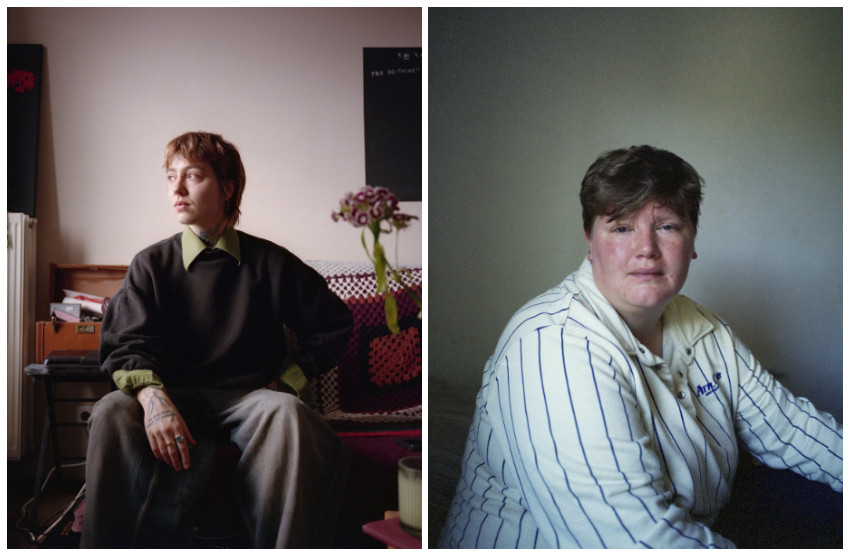
As a queer person myself, I’ve witnessed the backlash against queer and trans rights in recent years. This makes me feel called to stand up for “my” people. Since 2023, I’ve been working on a series called On Hold, about trans and non-binary individuals who are stuck on waiting lists for gender-affirming healthcare. Long waits for an initial consultation are a global issue. In the Netherlands, I photograph people on these waiting lists to raise awareness. The photo of Mika, part of On Hold, recently won a World Press Photo award. That prize helps tremendously in highlighting this problem, and I’m very grateful for that.
The mission of a photojournalist now
When you look at this year’s World Press Photo winners, so many stories are told that would otherwise remain invisible to the wider public. There are series about the queer community in Nigeria, about a house where people go to die peacefully, and of course images that expose the suffering caused by the war in Gaza. These stories contribute to awareness. They honestly and directly reveal what is happening in the world. I can’t speak for every photojournalist, but I believe we all strive to make sure these stories do not go unseen. They reflect the current state of the world.
How have all these years of being involved in photography changed your way of seeing the world? Where do you look up for beauty these days?
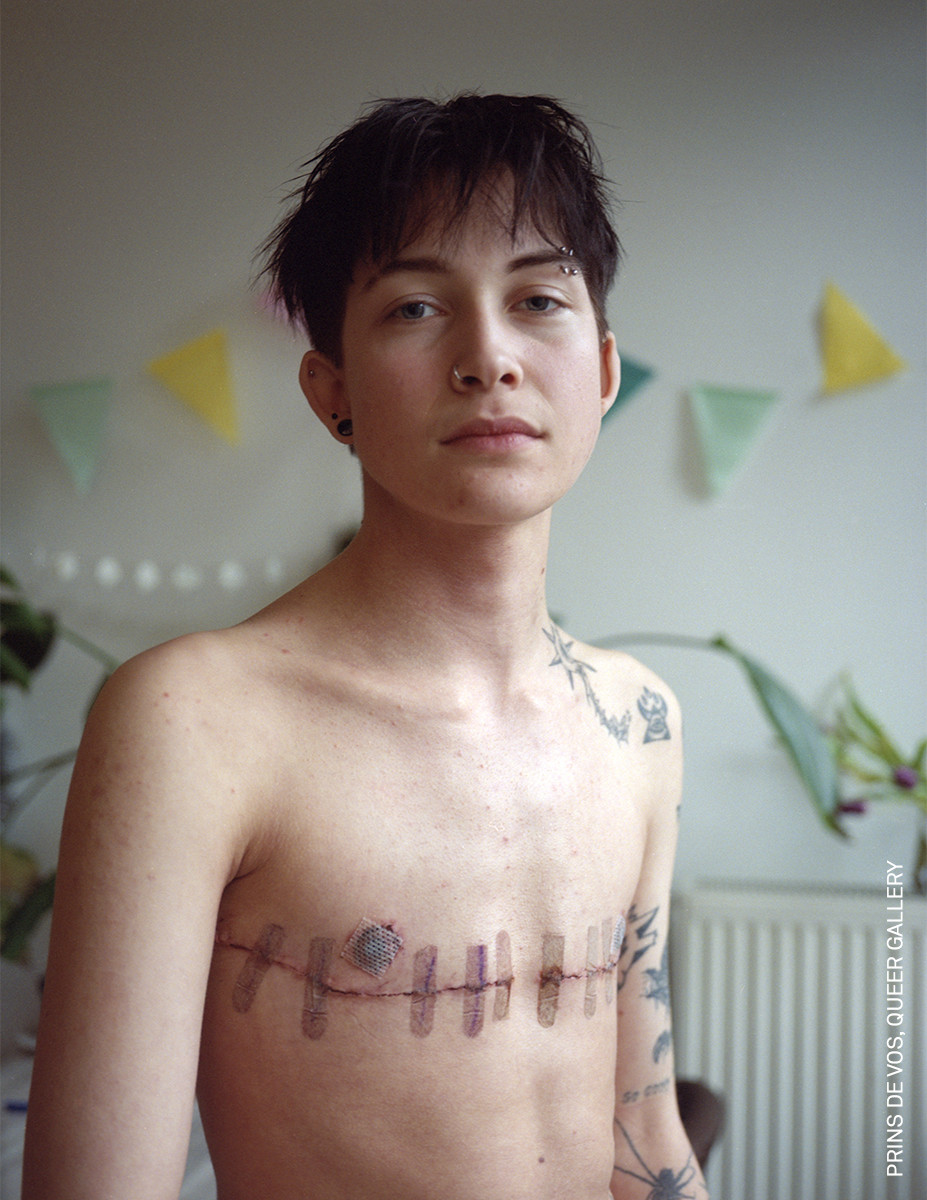
To answer that question quite literally: I see photography everywhere. When a strip of light hits someone’s face just right, I see a photo. When I’m alone and unsure what to do with myself, I start looking for something to photograph. I’ve trained myself to notice beauty in small things — a posture, a gaze, the way light falls. I love stillness, both in images and in the literal sense of the word. I’m not really a photojournalist. I’m a photographer who captures a marginalized group. A group often in the news due to violence, discrimination, or political debate. But no matter how turbulent the media coverage may be, I seek out quiet, peaceful moments where everything is simply okay. I hope people see that when they look at the photo of Mika (note: the work exposed at World Press Photo). Although there’s a lot of discourse around trans people, what you see is a beautiful young man who is simply happy to finally show his torso.
The essence of photography that has the power to move people
Photography is perhaps the most direct medium there is. That’s why it can be such a powerful force for change. I hope that one day, a series exposing the suffering of animals in factory farming will win a World Press Photo award. When you see it, you can no longer ignore it. Industrial animal farming is one of the biggest contributors to climate change, yet people continue to buy, eat, and use animal products. I believe that will change if we start exposing the horrific suffering behind the closed doors of slaughterhouses and massive barns. It’s the best-kept secret in the world. Why? Because cameras are actively kept away from those places. They know how powerful photography (and film) can be.
The project that you presented at World Press Photo
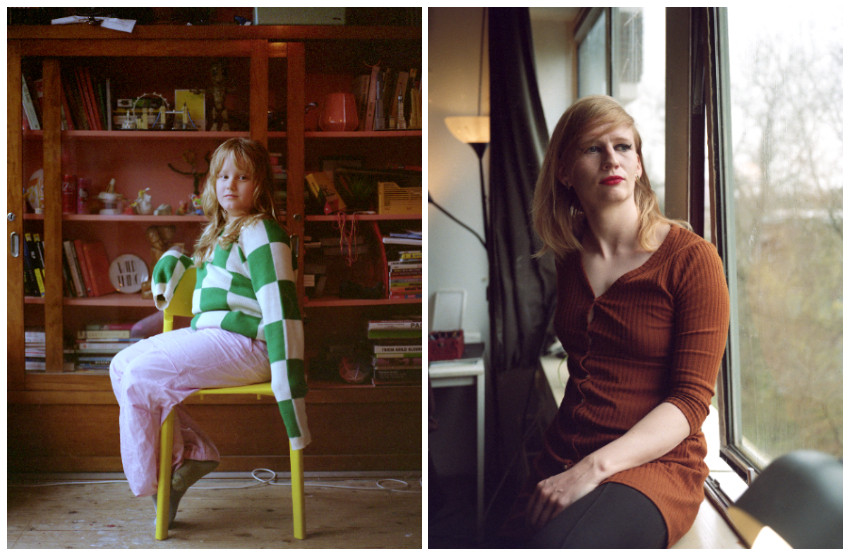
In 2023, I started the series because I was reading a lot about the topic and had close friends who were on a waiting list for gender-affirming care. In the Netherlands, the average waiting time for a first intake at a gender clinic is three years, but I photographed people who had to wait four or even five years. One of the reasons for this issue is that trans identities are still classified by the World Health Organization as a mental disorder in the Netherlands. As a result, trans people are required to go through a heavy and lengthy psychological assessment, even though what they need is physical healthcare.
What I want to show with my portraits is how diverse this group of people is, and how absurd it is that all of them are subjected to mental health screenings. The youngest person I photographed was 9, the oldest 64. What they have in common is that they are confident, smart people who know exactly who they are and what they need. It is absurd that, as a trans person, you are not allowed to make decisions about your own body. Not only cisgender people, but trans people too should have the right to self-determination.
The story of Mika
When I photographed Mika, he had already been on a waiting list for two years. In the Netherlands, you are required to complete the entire trajectory at a gender clinic in order to legally change your name and gender marker on your passport. However, if you have money, you can go to a private clinic for surgery. That creates unequal situations, because not everyone can afford an operation that costs thousands of euros. Fortunately, Mika managed to go through surgery with help from family and friends. At the time of the photo, he had just had his operation a week earlier, and I was the first person he allowed to see him shirtless. That was a special moment for both of us.
The reactions of public and jury
The jury was very pleased that I am bringing this issue to light. I'm still working on the series. They felt it is an important story that deserves more attention. The public response is more mixed. Not everyone understands it. But I always say: you don’t have to understand something in order to accept it. You may not be able to fully empathize with everyone and every situation, but we can look at each other with compassion and accept that we are not all the same, and that not everyone fits into a binary system. That is what makes humanity so rich and diverse.
What surprised you about the photos selected at Word Press Photo this year
I can’t look at the images without feeling angry, sad, or just deeply upset, and that says enough. The biggest themes this year were war and its victims, climate change, and the oppression of women and minority groups. Things are not going well for the human species, but that is not exactly news. I hope the selected photos help raise awareness of what is happening and encourage people to take action. When it comes to war, don’t stay silent, speak up. And ask yourself what you personally can do against climate change. This is not a time in which we can afford to keep consuming animal products, buying new stuff, or taking long-haul flights. The planet has been depleted, there is nothing left to extract.
The role of photography in 2025
In recent decades, photography has become more accessible. Everyone carries a camera with them every day, and most people use it daily. One of the photos selected by World Press Photo was even taken with a smartphone. Photography has become the most democratic and accessible medium there is. All you have to do is reach into your pocket. Not everyone can take great photos, but anyone can take meaningful ones. I want to encourage everyone to think about what matters to you personally, and what you want to document. You already have the tool with you. Think about which topics you want to make visible, what you want to highlight, and explore the medium. Hopefully, next year I’ll have even more competition at World Press Photo, because the more important stories we tell, the more we learn about the world and our place in it.