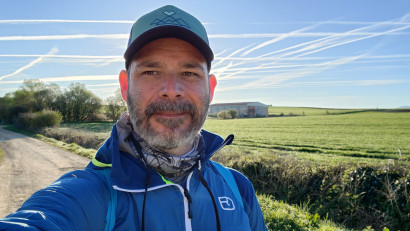
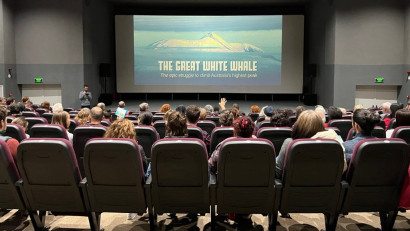
All over the world it feels like nature is becoming more accessible. If we look at the social media climate, there are definitely trends that might make us think people are more and more eager to spend time outdoors. But this comes with a price. How do we keep the environment clean and how do we continue to turn awareness into everyday behavior? Pedro Lacaz Amaral, CEO Gear Tips, Brazilia is also a member of the jury at the Alpin Film Festival 2026, taking place these days in Brașov, Râșnov și Bușteni.
"There are excellent content creators and digital influencers who take education, safety and environmental responsibility very seriously. But there is also a great deal of content that is incomplete, oversimplified or presented without enough context about preparation, risk, environmental impact and responsible behavior", says Pedro.
He says it is important to teach people how their actions affect trails, wildlife, water, vegetation and other visitors when they are outdoors. But sustainability should not stop when we leave the trail. How brands can use their influence to encourage better choices in everyday life and how sustainability can regain its respect from clients are just a few topics we addressed in the interview below.
The story behind Gear Tips
Gear Tips was created in 2016, but my relationship with the outdoor world started much earlier. I began climbing in the early 1990s and have worked professionally in the outdoor industry since 1998.
For roughly 25 years, until 2024, I worked directly with international outdoor brands in Brazil, including Deuter, CamelBak and Sea to Summit, through distribution, market development and brand management. This gave me the opportunity to follow very closely the evolution of the outdoor market, equipment, consumers and outdoor culture in Brazil.
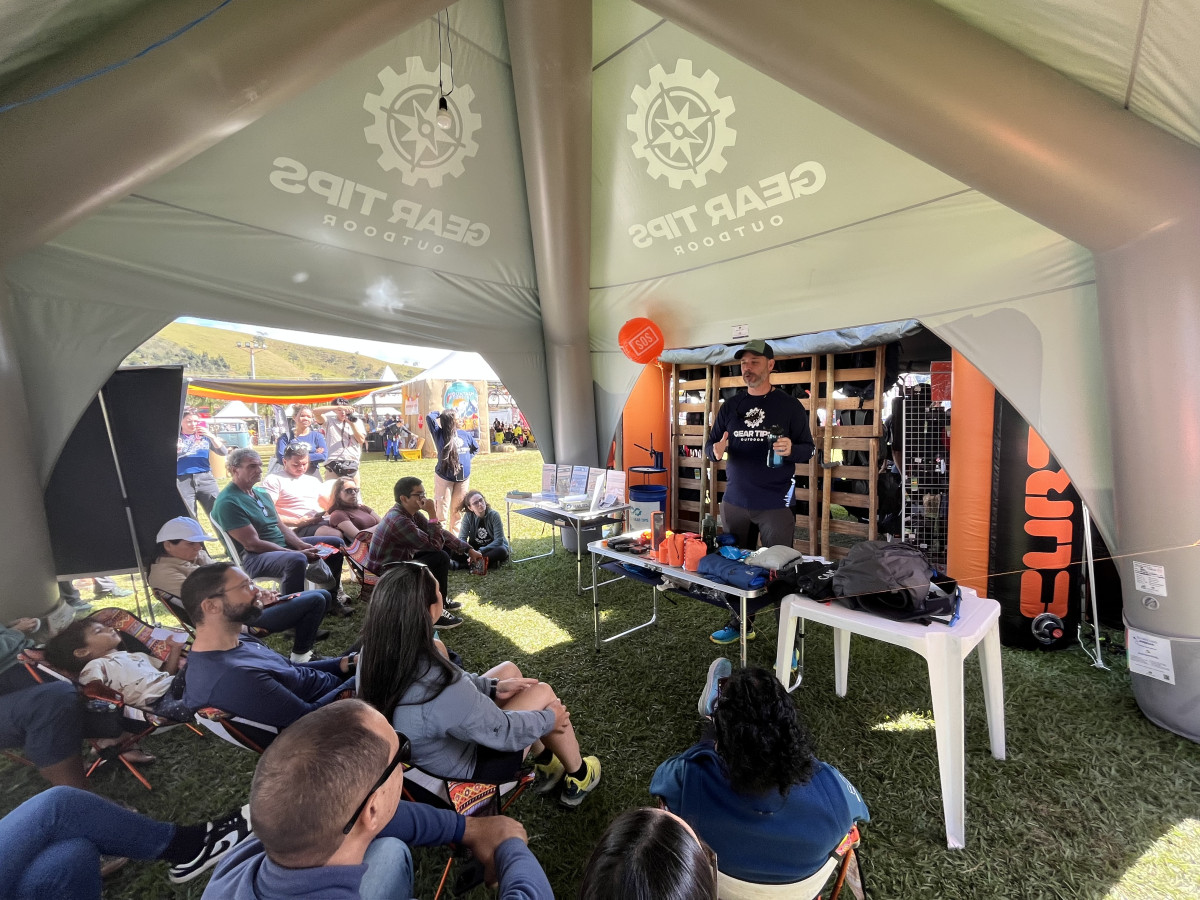
Gear Tips initially began as a content platform focused on equipment and outdoor knowledge, but over time it evolved into something much broader. Today, I see it as an educational ecosystem with a simple purpose: to inspire, connect and empower people who want to experience nature, as well as the professionals who make those experiences possible.
We work through content, courses, events, professional training and initiatives related to safety, sustainability and outdoor culture.
How much has the outdoor industry changed in the past 25 years
Enormously. Over the past 25 years, access has changed dramatically. In Brazil, and around the world, people now have much easier access to information, equipment and opportunities to travel, both domestically and internationally. Activities and destinations that once required a great deal of specialized knowledge to discover have become much more accessible.
This is a very positive transformation because many more people are being inspired to experience nature.
At the same time, I believe one of our greatest challenges today is that access and inspiration have grown faster than preparation and education.
Social media is a good example. It has played an extraordinary role in encouraging people to discover trails, mountains and outdoor activities. But inspiration does not necessarily provide the knowledge required to practice those activities safely and responsibly.
There are excellent content creators and digital influencers who take education, safety and environmental responsibility very seriously. But there is also a great deal of content that is incomplete, oversimplified or presented without enough context about preparation, risk, environmental impact and responsible behavior.
So, in my view, one of the major challenges for the outdoor industry today is no longer simply helping people reach nature. It is helping them arrive there better prepared, technically, physically, mentally and environmentally.
The growth of outdoor recreation is very positive. Our responsibility now is to make sure that education grows with it.
The most important conversations happening right now
For me, one of the most important conversations is how to make outdoor recreation grow without destroying the very places that attract people to it.
We need to talk about visitor education, environmental impact, professional qualification, risk management and the responsibility of companies, guides, athletes, events and outdoor communities.
Another important discussion is the difference between simply telling people to “protect nature” and actually teaching them how to behave in natural environments.
Awareness is important, but education needs to translate values into practical decisions.
Problems in educating people
There is growing environmental awareness in Brazil, especially among people who already have a connection with nature and outdoor activities.
However, I believe the biggest challenge is turning awareness into everyday behavior.
Of course, it is important to teach people how their actions affect trails, wildlife, water, vegetation and other visitors when they are outdoors. But sustainability cannot stop when we leave the trail.
In fact, perhaps the most important part happens in our daily lives, because that is where we spend most of our time and where we make most of our choices.
What we buy, what we eat, how we deal with waste, the companies we support and the products we choose can have an environmental impact far beyond the few days we may spend hiking, climbing or camping each year.
That is why, at Gear Tips, we have gradually expanded the conversation beyond outdoor practices. We are producing content about subjects such as composting, agroforestry systems and more responsible consumption, while also highlighting outdoor equipment and brands that are genuinely trying to reduce their environmental impact.
For me, educating people to love nature also means helping them understand that their relationship with nature continues when they return home.
The goal is not simply to create more responsible outdoor users, but to encourage people to make better-informed choices in different areas of their lives.
Concerning issues in Brazil regarding the outdoors
One of the biggest challenges is the rapid growth of outdoor recreation without the same speed of development in infrastructure, education and visitor management.
In popular destinations we increasingly see trail erosion, shortcuts, waste, overcrowding and pressure on sensitive environments.
Fire is also an important issue in many regions.
Another concern is professionalization. Outdoor activities involve real risks, and improving the qualification of guides, instructors and organizations is essential.
For me, conservation, education and safety are deeply connected. A well-prepared visitor or professional usually makes better decisions both for people and for the environment.
Gear Tips Empowerment Programs
Leave No Trace is an education program focused on teaching people to reduce their impact when visiting natural environments.
What I value most about Leave No Trace is that it goes far beyond a list of principles or rules. It is about education, decision-making and understanding the consequences of our choices.
At Gear Tips, Leave No Trace is not limited to the courses we teach. It has become part of the way we think about our activities, our communication and the experiences we create.
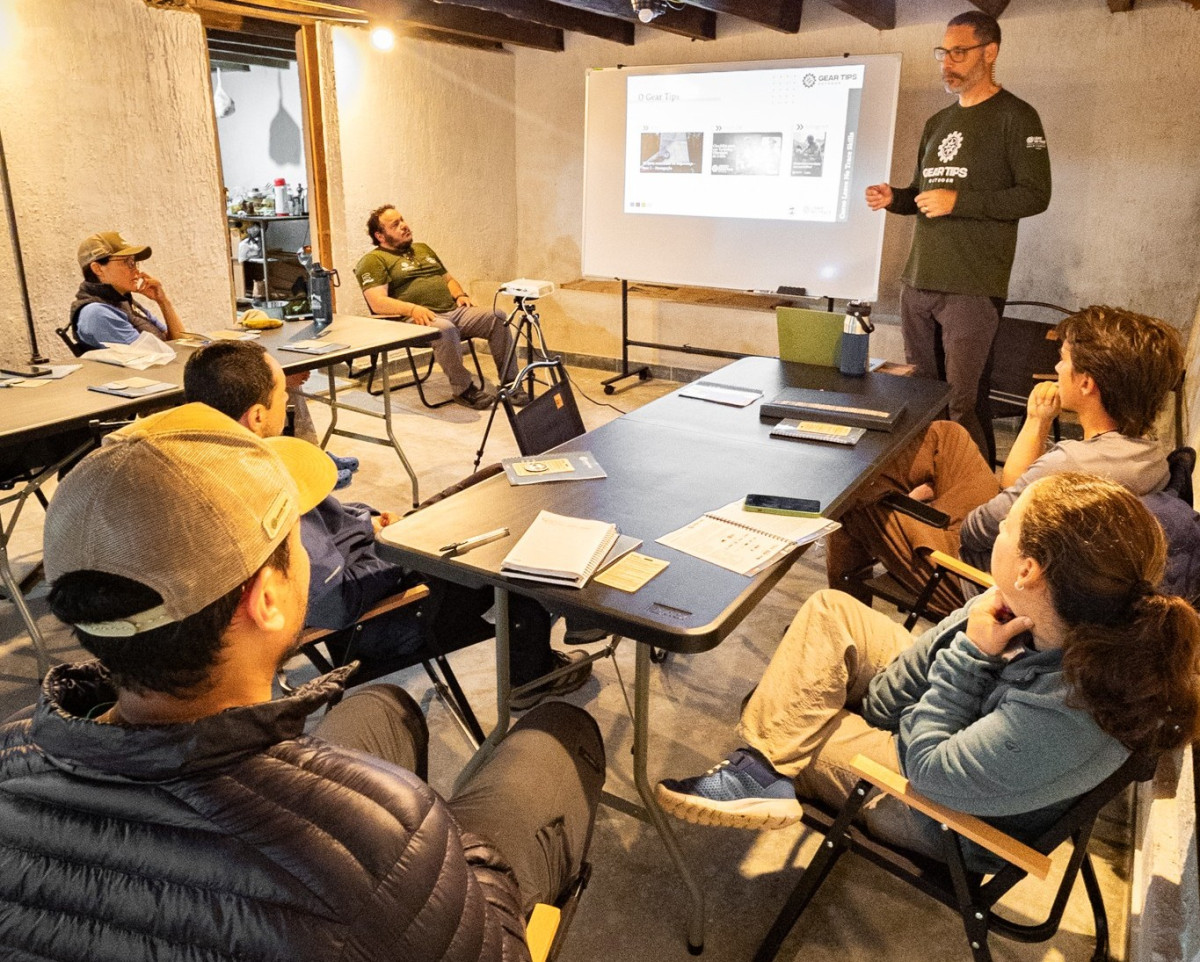
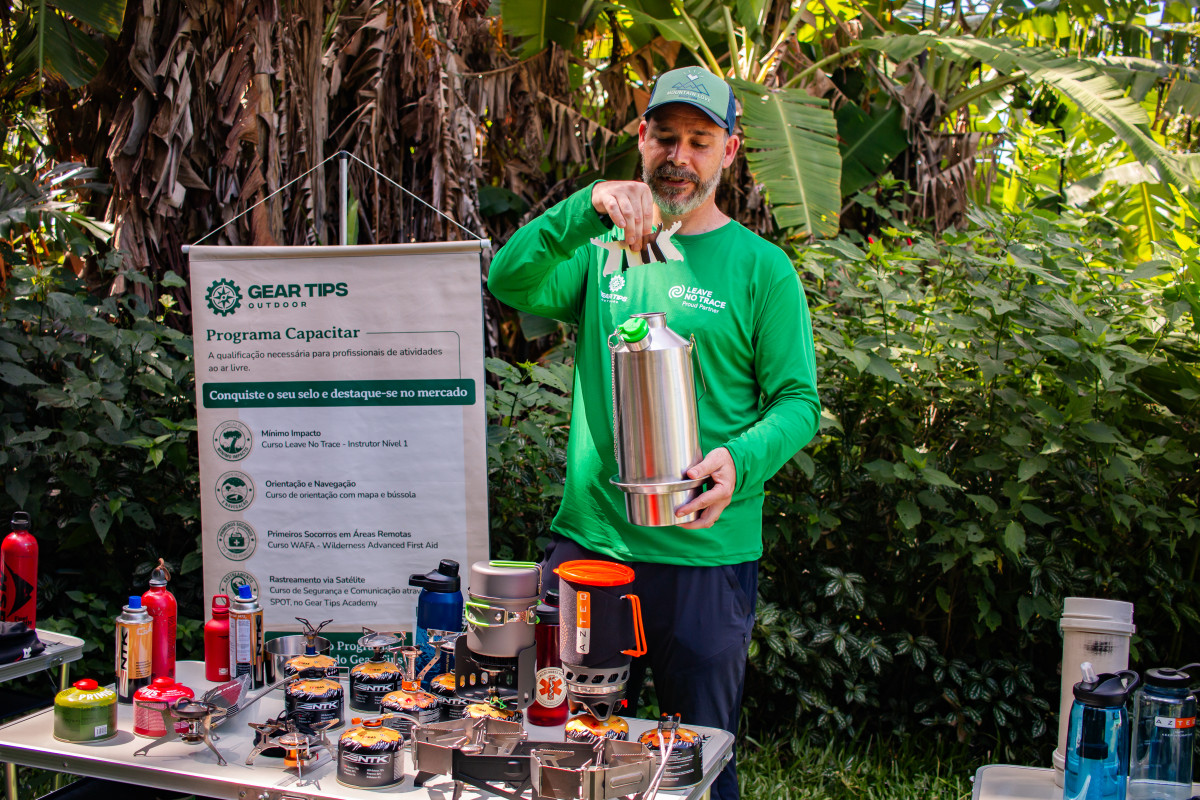
Of course, we offer specific Leave No Trace training through Programa CAPACITAR (Gear Tips Empowerment Program), our professional education program. But we also try to incorporate these concepts into other courses, events, articles, videos and conversations with the outdoor community.
And we try to go beyond Leave No Trace itself.
For example, we work to reduce and compensate for the environmental impact of our own activities, including offsetting carbon emissions associated with some of our programs and events. We also discuss waste, responsible consumption, equipment choices and other practical ways of reducing impact.
Through Programa CAPACITAR, we provide training not only in Leave No Trace, but also in wilderness first aid, outdoor cooking, risk management, technical standards and other competencies that are important for outdoor professionals.
Over the past few years, hundreds of professionals have participated in our in-person programs across Brazil, while thousands more have been reached through online education.
Our objective is to strengthen the outdoor professional community, but also to encourage a broader culture in which safety, quality, education and environmental responsibility are treated as interconnected issues.
For me, Leave No Trace is therefore not simply one of the courses we offer. It is one of the foundations that helps guide the way we think about outdoor education as a whole.
The Alpin Film Festival in Romania
First of all, I am very happy to have been invited to be part of the jury. Mountain film festivals are extraordinary meeting points between cinema, outdoor culture, environmental issues and human stories.
Through the films I have already started discovering aspects of Romania that I knew very little about, especially its forests, rural communities and mountain culture.
I am very curious to experience the Carpathians, meet people from the Romanian outdoor community and better understand the relationship Romanians have with their mountains and forests.
And, of course, I am looking forward to the conversations that happen around the films. Often, those conversations are as valuable as the screenings themselves.
Outdoor brands and the planet
Outdoor brands have a particular responsibility because they influence much more than purchasing decisions. They also influence how people think about nature, adventure and consumption.
Of course, product-related initiatives are important. Using RDS-certified down, developing bluesign® products or being part of organizations such as the Fair Wear Foundation are meaningful steps, as are improvements in traceability, durability, repairability and end-of-life solutions.
But I believe brands need to go further than talking only about the sustainability of their products. Many consumers end up seeing certifications and environmental claims simply as part of a marketing strategy, so the challenge is to show that the commitment is real and goes beyond communication.
Brands can use their influence to encourage better choices in everyday life as well: consuming less, repairing instead of replacing, taking better care of equipment, thinking about waste, travel and the broader impact of our decisions.
For this to work, it has to be consistent and authentic. People quickly notice when sustainability is being used mainly to gain visibility. A real commitment should be reflected in products, internal practices, partnerships and communication.
I believe brands can play a very important role when they help people make more conscious decisions, both outdoors and in their daily lives.
The most beautiful secret about Brazil’s outdoors
I think one of the things people outside Brazil sometimes underestimate is the extraordinary diversity of landscapes and ecosystems we have. Brazil has six major terrestrial biomes: the Amazon, Atlantic Forest, Cerrado, Caatinga, Pantanal and Pampa. They are very different from one another, not only in terms of landscape, but also climate, vegetation, wildlife and the way people live and interact with nature. The Caatinga, for example, is a semi-arid environment with vegetation adapted to long periods of drought, and it is the only biome found exclusively in Brazil.
Brazil also has 74 national parks, protecting very different landscapes across the country. And sometimes nature is much closer to our cities than people imagine. In Rio de Janeiro, Tijuca National Park protects almost 4,000 hectares of Atlantic Forest in the middle of the city. ICMBio describes it as the largest urban forest in the world replanted by humans.
But perhaps one of Brazil’s best-kept outdoor secrets is that Brazil is also a mountain country. Internationally, people usually think first about the Amazon and our beaches, but we also have extraordinary mountain landscapes. The mountains of the Atlantic Forest are particularly special to me. Serra do Mar, Serra da Mantiqueira, Serra da Bocaina and Serra dos Órgãos combine dense forests, waterfalls, granite walls, high ridges and enormous biodiversity.
In some parts of the Atlantic Forest mountains, you can spend hours hiking through dense forest and eventually emerge onto an exposed rocky ridge with extraordinary views. That contrast between tropical forest and mountain landscapes is one of the things I find most special about the Brazilian outdoors.
Brazilian outdoor culture is much more diverse than most people outside the country imagine.
The differences between Europe and South America
It is difficult to generalize because both Europe and South America are extremely diverse, but one difference I often notice is the level of infrastructure and how this shapes the outdoor experience.
In many European mountain regions there is a long tradition of marked trails, mountain huts, alpine clubs, rescue systems and established structures for managing visitors. This creates a very organized relationship with the mountains and, in many places, allows people to access nature with a strong support network around them.
In many parts of South America, outdoor experiences still require more self-sufficiency. Distances can be much greater, infrastructure is often more limited and access can be less structured. This changes the way people prepare, plan and move through the landscape.
In Brazil, however, this has been changing significantly. One important initiative is Rede Brasileira de Trilhas de Longo Curso, the Brazilian trail network, which works to connect trails across the country and organize them as part of a broader system. The idea goes beyond recreation: these trails can connect protected landscapes, support conservation, encourage sustainable tourism and create opportunities for the communities along the routes. In 2026, Brazil also formally created the National Trail System — Sintrilhas, expanding this approach to the planning, management, recognition and promotion of trails throughout the country.
I do not see one model as better than the other. Europe has built an extraordinary mountain culture and infrastructure over generations, while South America still has vast areas where remoteness and a stronger sense of wilderness remain very present. At the same time, countries such as Brazil are developing more structured trail systems while trying to preserve this connection with natural landscapes.
I think there is a lot we can learn from each other, especially when it comes to balancing access, safety, conservation, local development and the preservation of the character of wild places.