It’s easy to fear new things, but healthier to look at what you can actually do with them, believes Nick Docherty, Chief Strategy Officer Wieden+Kennedy Amsterdam. We’re talking about AI, of course, and the way technology promises us a better life, but before we get to that future, we still have to wade through the slop of the present.
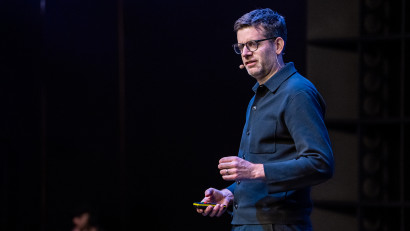
On the Creativity 4 Better stage, the global conference organised by IAA Romania in Bucharest, Nick spoke about how the boundaries of the industry are being redefined, the need to embrace creative risk, and the importance of pushing beyond convention.
"When so much content is being churned out, there needs to be a filter. I love the technology in particular, it has given more of us outlets to be creative. That's got to be a good thing across the board, for kids, for adults, for whoever. But I do think, though, that you also need experience to add to that", says Nick.
During a break at the conference, we talked with Nick Docherty about magic and slop, his complicated relationship with AI, sci-fi scenarios and dissonant reality, the fears of this moment and where optimism still finds room to hide.
What worries you in the advertising world
The commoditization of the services that advertising offers. The industry, as a whole, has been very bad at proving that it adds value to businesses and there's a race to the bottom.
Not everywhere, but in some places, it's about creating ads that win awards for awards sake, but don't do the bigger job of solving client business problems. And that's a problem because it kind of infects the industry. So if I'm worried about anything, I think it's that.
Fears & optimism
It's just it depends how you look at the new things that come along. It's easy to fear things. I think it's more difficult, but better to embrace it and see what you can do with it. At Wieden+Kennedy Amsterdam, we've been experimenting with AI tools, we've been pointing ideas at them. It's been extremely useful for us to make things we wouldn't have been able to make before.
I'm excited about that. I'm always excited about new things that we can point creativity at.
First impression of AI
My first impression was extreme excitement. Like it was magical. There's a quote, a famous quote from Arthur C. Clarke: Any sufficiently advanced technology is indistinguishable from magic. And AI felt a bit like that, it felt like magic.
When I first used chat GPT and it could create a story that I prompted, I was like, Jesus Christ, this is the future. So I was originally extremely excited. And then, I guess, I went through that typical curve where I'm like, Oh, actually, it has severe limitations.
You put in shit, you get out shit, you put in good stuff, you get well, maybe not shit, but still quite average stuff. And then I think I've come back to AI being interesting to use for some things and others, so it's been a bit of a journey.
AI influence in the industry
There's some bits of very bad work. I think what I'm mostly hearing and seeing is clients using it as an excuse to cut agency fees. It's a concern, obviously, for somebody who's running an advertising agency. But there's just a lot of uninformed hype around it.
There's so much noise, it's difficult to find the signal.
Cutting through the noise
First of all, you've got to stay true to who you are. It's tempting to just just go off on mad tangents and just go over here or over there.
It's become even more important than ever to know who you are as a brand, to have a real voice, a distinctive voice, and then to execute that in lots and lots of different ways. But if you don't know who you are, you're fucked. To cut through, you always need to be thinking about who you are and therefore what you should be doing, not just in advertising and marketing, but as an organisation.
When you know who you are, it's much easier to go into this category or think about how your pricing policy is working. There are companies who think the brand is just skin deep and companies that think that brand goes all the way to their soul. And the last ones are the ones that are going to succeed.
It's easy to get distracted by the noise. People still go and watch movies that go for two and a half hours. And they watch six second Tik Tok videos. As a brand, you can do either or something in the middle. But it needs to be relevant, and it needs to be interesting enough to cut through the noise. The role of creativity is more important than ever, in my opinion, because so many things have already been done.
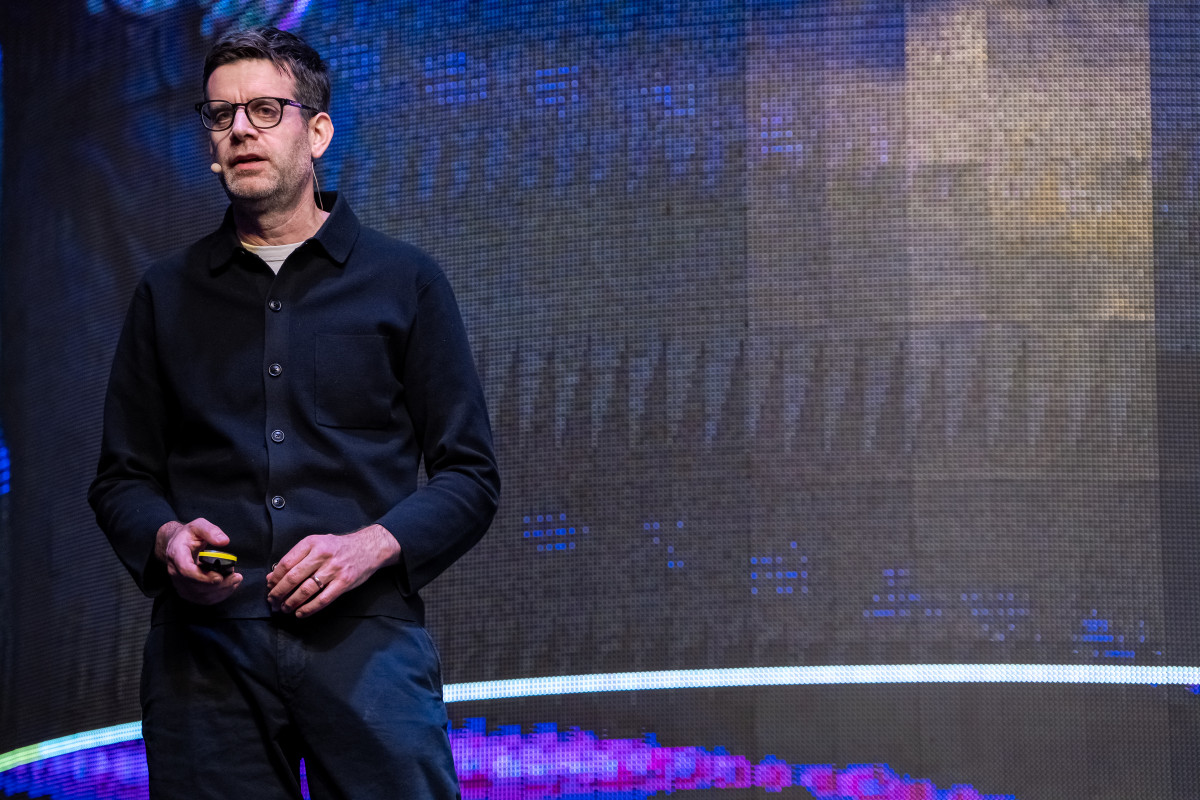
Nick Docherty on the Creativity 4 Better stage, Bucharest, 2025
A myth about creativity
There's a myth that says, particularly in the age of AI, that anybody and anything can be creative. And I think that's probably true. But I think it's also true that not everybody has a taste or the ability to distinguish between a great idea and just a good one. That's where it's going to begin to matter more.
When so much content is being churned out, there needs to be a filter. I love the technology in particular, it has given more of us outlets to be creative. That's got to be a good thing across the board, for kids, for adults, for whoever. But I do think, though, that you also need experience to add to that. And understanding what how businesses work and brands tick.
A name for the advertising ecosystem in 2025
The age of slop. It's so much crap. There's a lot of good stuff as well, but you have to wade through the crap in order to find the great stuff.
Not to say that everything is slop, but I think the majority of stuff that is produced.
There was a science fiction writer Theodore Sturgeon, and he produced something called Sturgeon's Law. He was frustrated that everyone thought he was a science fiction writer. He wasn't a proper writer. He was like: 90% of everything is shit. 90% of science fiction is shit. I'm in the 10% that I need to be at the top end.
And you can apply it to art or advertising, 99% is probably shit. But you need to be in the 1% that is awesome.
That's becoming ever more important because the the sheer amount of stuff out there, 50% of all new content on YouTube is AI generated.
How was the advertising industry when you started
It's quite exciting because I was a managing consultant before and a strategy consultant. And that was incredibly boring. It was useful, made me understand about business.
Advertising felt more exciting because you could create an ad that could transform the fortunes of a company almost overnight. Sometimes that was the goal, because advertising had a greater stature, a greater importance than it does now, for sure. There's so many different channels now, that one ad is not going to do anything for you. Back then, it was so big.
A lot of clients just treat advertising agencies as an execution machine now. There was a bit more of clients treating advertising agencies as a partner.
How did your role change
In a way, it hasn't changed a huge amount. I'm still there to give direction to the brands that we work with, and kind of help them imagine new futures. CEOs and CMOs are so into the day-to-day of their lives that sometimes they need outsiders to come in and say, how do you think about this? My role is perspective and direction. To help solve the challenges that people are facing.
The negotiations between the strategy and the creative
It should just be a conversation. It shouldn't be a negotiation. I think strategy should be a creative act. Creativity isn't a job title. It should exist in everybody in the agency at some level.
The power of advertising in 2025
I think it's a weaker force than it once was. I think creativity and thinking about brands and businesses has never been more important, never had more value. But it needs to be at a holistic level, not just very specifically targeted advertising.