
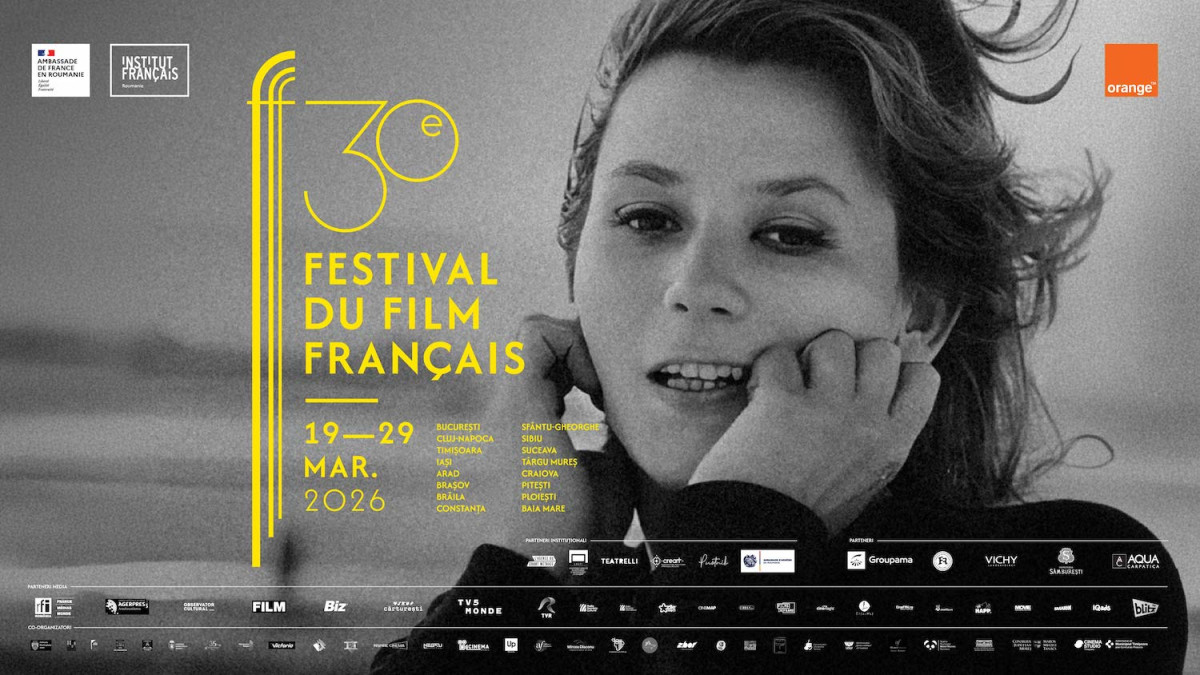
For 30 years, the French Film Festival has created, each spring, a particular kind of encounter between films and audiences. This year’s anniversary edition, which began on March 19, marks the festival’s expansion to 16 cities, bringing auteur cinema closer to audiences in places where it is less accessible.
The 2026 edition is coordinated by Armand Paulais, who speaks about this year’s themes - identity, family, war, migration, belonging - not simply as film subjects, but as questions that run through all of us, wherever we are. In today’s French cinema, they emerge naturally, as a response to the tensions and changes of the world we live in.
„Cinema is an art that responds to our societies and our politics. It is precisely through art that we are able to reposition ourselves and question what we take for granted. Cinema is extraordinarily powerful in that regard and it achieves this not only through its subjects, but through its forms”, says Arman.
We spoke with Armand Paulais about his relationship with cinema, the directions shaping French cinema today, an increasingly attentive and demanding Romanian audience, and the work behind a festival that continues to grow year after year.
The French Film Festival is organized by the French Institute in Romania in Bucharest, Cluj-Napoca, Iași, and Timișoara, with the support of the French Embassy in Romania, and runs until March 29.
How your relationship with cinema began
Cinema came into my life the way it does for most people, through emotion first, and understanding later. There was a period in my adolescence where films became a kind of secret world: a space where I could encounter lives completely different from my own, and yet find something deeply familiar in them. That experience of recognition through difference is, I think, what cinema does better than any other art form.
As for curation, I came to it gradually. I realized at some point that what excited me was not just watching films, but thinking about how films speak to each other, how a program can create a conversation, how the order and context in which you encounter a work transforms the way you receive it. Curation is a form of authorship. You are not making the films, but you are shaping the experience through which they reach an audience.
With this edition, I have truly tried to share the pleasure I take in watching films and talking about them, and I hope that desire to share comes through in the selection we built with Dalesia Cozorici, and in the festival as a whole.
The most interesting directions in French cinema in recent years
Several things excite me right now. There is an extraordinary generation of women directors who are reshaping the landscape of French cinema. They are bringing a different sensibility to every possible subject: genre films, family dramas, political stories, coming-of-age narratives. In this year’s selection alone, fourteen films are directed by women. That is a fundamental shift in what French cinema is.
I am also struck by a genuine spirit of formal experimentation that is becoming something larger than a trend. Directors like Alice Diop, whose Saint Omer dissolved the boundary between documentary and courtroom drama; Julia Ducournau, whose Titane and Raw transformed body horror into a vehicle for identity and desire or Coralie Fargeat, whose work operates at the intersection of body horror and feminist theory are reinventing genre. This emerging tendency is beginning to define a new artistic wave that is gaining recognition in international festivals and is increasingly finding audiences beyond France. It is not necessarily a cinema I always respond to personally, but I find this new direction genuinely interesting and inspiring — particularly in its boldness of not proposing a narrative-driven cinema, but of approaching filmmaking as a plastic art.
And then there is also the way French cinema looks beyond its own borders. France is the world’s leading country for international co-productions in auteur cinema. It reflects a desire to engage with subjects that are not only French, but global. In a world shaken by the proliferation of conflicts and wars, there is a growing need for a transnational art that asks what we are living through together. French cinema, at its best, has always understood that.
The relationship between Romanian audiences and French cinema today
The relationship has deepened in ways that are genuinely moving to observe. Thirty years ago, there was an element of novelty to French cinema for many Romanian viewers. Here was a window onto a European world that had been closed off for so long.
What I see today is something different: a familiarity, a critical engagement, an audience that knows French cinema well enough to have preferences, to disagree, to be demanding. Romanian viewers today are not passive recipients of French culture. They compare directors, they remember previous editions, they come with expectations. The Romanian public is also a very demanding audience when it comes to the quality of films. They will not come to the cinema simply because a film is French, but because, beyond the language, the film genuinely interests them. That is also a challenge for us, because it pushes us to be very rigorous in our selection. In the end, what matters is not the nationality of a film, but its quality.
The French Film Festival at its 30th edition
For the French Institute in Romania, this anniversary is both a celebration and a reaffirmation. Thirty years without interruption, through political changes, economic crises, a pandemic, is the evidence of something real and lasting in the relationship between our two cultures. The festival has become one of the cornerstones of the Institute’s mission, a moment each year when everything we believe about the power of cultural exchange becomes concrete and visible.
Directing this edition is, for me, a genuine honour. The French Film Festival in Romania was founded in 1996, before I was born. To be entrusted with its 30th anniversary is something I find deeply meaningful and challenging. Working on this edition, I thought often about continuity, how the concerns of La Haine are still alive in Les Indésirables today, how questions that obsessed French cinema in the 1990s are still being asked, in new forms, by the next generation. That continuity is humbling. It is also an invitation: not to rest on what has been built, but to take it somewhere new.
What’s new this year
This year is our most ambitious edition in terms of scale and structure. We are present in 16 cities, the largest geographic reach in the festival’s history with 4 new cities compared to last year: Ploiesti, Pitesti, Craiova, and Baia Mare. We have launched three new programs: a school program that brings French cinema directly to high school students; a student program that expands the festival’s presence in universities; and professional days that create a structured space for Franco-Romanian industry dialogue.
In terms of scale, this year we are expecting around 10,000 spectators across a total of 127 screenings throughout the country. This is a reflection of the ambition we want to give the festival and the real appetite for this kind of cinema across Romania.
What defines the importance of the festival today is its role as a space for genuine dialogue. In a world saturated with content, a festival offers something different: a shared experience, a curated encounter between a film and an audience that chooses to be there. The conversations that happen after a screening, the meeting between a filmmaker and a viewer from another country. They are what a festival is for, and they are what we protect. That is why, throughout the festival, we have tried to create as many opportunities for exchange as possible — with directors (Lucile Hadzihalilovic, Dominique Cabrera, Nae Caranfil), with Romanian film critics such as Ionuț Mares and Andrei Gorzo, and with French industry professionals who shed light on the hidden side of filmmaking, such as Juliette Schrameck. These moments matter deeply to us, and we genuinely encourage audiences to join us for them.
The main criteria for building the selection
The first and most fundamental criterion is artistic quality. We watched hundreds of films over the course of the year, and the ones that made it into the program are those that left a lasting impression through the strength of their direction, the originality of their subject, or the emotional truth of their storytelling. Recognition at major festivals matters to us as a signal, but it is never sufficient on its own.
The second criterion is novelty for the Romanian audience. We made a strict rule: no film that has already been distributed in Romania. With the exception of a few special screenings, every film in the selection is a Romanian premiere. For many of the titles — Miséricorde, Mektoub My Love: Canto Due, Promis le ciel — this festival is the only opportunity to see them on a big screen in this country. They might never receive Romanian theatrical distribution, and the festival serves precisely this purpose: to offer Romanian audiences access to a novelty that exists nowhere else.
The third criterion is diversity as a genuine curatorial value. The selection should offer a panorama: different genres, different tones, different generations of filmmakers, different subjects. A selection that reflects only one vision of French cinema would be a distortion and one that could only speak to a fraction of our audience. We want every festivalgoer to find something that speaks to them.
Challenges and rewards in organizing such a festival
The first and most significant challenge was taking over a festival with so much history and so loyal an audience. I did not arrive with my ideas and my ambitions already fixed. I tried, first, to listen and understand the history of the festival, its place in Romanian cultural life, the expectations built up over thirty years. To build something with that history, and for the Romanian public. My role was then to bring something of my own: a new stone added to an already remarkable edifice, so that even after 30 years, the festival continues to reinvent itself alongside its era and its audience but always, and I truly insist on this point, in dialogue with the festival’s teams, to create an edition that reflects our shared ambitions and that we can carry together as a team.
The practical challenges are also significant: rights negotiations, subtitling, logistics across 16 cities, coordinating with dozens of partners and co-organizers across the country. These are the infrastructure questions that occupy a great deal of time and energy, and they require real expertise and care.
Actually, one of the specific rewards is when you take a genuine risk with a film and you see it pay off. L’Engloutie by Louise Hémon is a very particular film: shot on celluloid in the French mountains, slow, contemplative, deeply authorial. We genuinely did not know whether it would find its audience at the festival. And yet the Bucharest screening is already almost sold out. Seeing that a bold bet can pay off is one of the things that drives us to keep taking risks — and to keep proposing to our audience films that might unsettle them, or surprise them in ways they didn’t expect.
But the most beautiful reward the festival can offer is something simpler: seeing an audience that is genuinely moved. A few years ago, I was coordinating a festival in Martinique, and after a screening a woman came to find me just to thank me, with a sincerity and an emotional directness that I was not prepared for. That moment has stayed with me. For me, it is the most beautiful gift this work can give.
What goes into the work behind each edition
The selection process begins well before the festival itself. Throughout the year, we follow the major international festivals (Cannes, Berlin, Locarno, Venice, Sundance), tracking what French cinema is producing and how it is being received. We watch films continuously, maintain relationships with French distributors and producers, and stay in dialogue with the CNC and Unifrance, which give us an invaluable view into emerging talent and upcoming productions.
For each section, the process is slightly different. The Panorama requires broad coverage. We need to have seen enough to genuinely claim it represents the best of the year’s French output. The Young Talents competitions require a sharper focus on first and second features, and on tracking the new voices that are just beginning to build their careers. The Heritage section requires a different kind of historical thinking: understanding which classics have aged well, which dialogues between past and present are genuinely illuminating.
The Short Film Competition this year has an additional dimension: it was curated by master’s students from UNATC, based on a selection of short films made by Dalesia Cozorici, the festival’s other programmer. Exchanging with those students and giving them this carte blanche over the short film competition was one of the most rewarding parts of preparing this edition and the short films in this year’s selection are simply extraordinary. I have a particular affinity for this format, which allows far more room for experimentation. The seven short films we are presenting this year come from the world’s most prestigious festivals and are, in themselves, a complete experience.
What themes like identity, family, war, or migration reveal about the world
French cinema has always been a mirror of the society that produces it. The themes you mention are not chosen by filmmakers arbitrarily; they are the questions that are urgent today and not only in France. Cinema is an art that responds to our societies and our politics. It is precisely through art that we are able to reposition ourselves and question what we take for granted. Cinema is extraordinarily powerful in that regard — as painting or theatre were in other eras — and it achieves this not only through its subjects, but through its forms.
One question that has returned with particular insistence in recent years in French cinema is the question of belonging (to a place, a culture, a generation). It is a question that reveals a great deal about where younger generations find themselves, and it manifests across films in many different forms. Nino, which follows a young man who feels somewhat lost in contemporary life; Partir un jour, which uses the return home as a way to interrogate roots and identity; Promis le ciel, which reframes the migration story from inside Africa rather than from the European shore all illuminate these questions in remarkably different ways.
There is also a recurring sense of social unease as a cinematic subject (anxiety about the environment, about the place of young people, about the coherence of the social fabric). And these concerns are today not only French but global — which is precisely what gives these films their power to resonate with audiences everywhere. The strength of cinema lies in its ability to transform preoccupations into art, into something beautiful; and in doing so, like Greek theatre before it, it becomes a space for genuine catharsis.
The Panorama section as the core of the festival: this year’s cinematic focus and selection criteria
The Panorama is designed to be exactly what its name suggests: a wide, honest view of French cinema in a given year. Not a highlight reel, and not a thematic argument, but a genuine cross-section — films that represent the full range of what France is producing at its best.
This year, that means presenting both demanding art-cinema titles and more accessible films. It means including comedies alongside dramas, crime films alongside intimate portraits. We made a deliberate effort to balance established directors — Abdellatif Kechiche with Mektoub, My Love: Canto Due, Alain Guiraudie with Miséricorde, François Ozon opening the festival with L’Étranger — with less familiar names whose work deserves to be seen on a large screen.
The “Heritage: 30 Years of French Cinema” section as a new addition. The importance of a retrospective perspective
I should be honest: this section was genuinely difficult to build, and it took a long time to find its shape. Dalesia Cozorici and I spent about six months working through the idea together, in ongoing dialogue. The initial ambition was to show 30 significant films from the 30 years of French cinema — one for each year, a kind of comprehensive retrospective. But we quickly realised that we could not show everything in 10 days, and that a simple list of great films was not enough.
The section evolved as we understood that what we needed was not just a collection of important films, but a set of dialogues. We needed to build a conversation between films, to find the pairings and juxtapositions that would generate genuine meaning. That process of selection and framing — asking not just “which films matter?” but “which films speak to each other?” — led us to some of our most interesting choices. We were drawn to the idea of celebrating films that were themselves turning thirty, which led us, among other things, to La Haine, released in cinemas in 1996 — the very year the festival was founded.
When we placed La Haine alongside Les Indésirables, we were not simply saying “here are two great films about the banlieue.” We were inviting the audience to trace a line: to see how the questions Mathieu Kassovitz asked in 1996 are still being answered, or refused, or complicated, thirty years later by Ladj Ly.
The same logic governs the pairing of La Jetée with Dominique Cabrera’s documentary Le Cinquième Plan de La Jetée, shot in 2025. These films are in genuine dialogue — across seven decades — and that dialogue reveals something about cinema’s own capacity for memory and renewal.
The “Young Talents” competition and the new generation of French filmmakers
The Young Talents competition this year brings together four films — all selected at Cannes — that share a genuinely contemporary gaze on the world. What unites them is a refusal of the expected: a musical that explores grief and belonging, a contemplative portrait of a young man adrift, a genre film burning with political energy, a road story that captures the restlessness of a generation. These are not films that play it safe. And I think they will genuinely surprise Romanian audiences — in the best possible way. Introducing new authors and proposing new cinematic forms is exactly what we want to champion through the festival. One of our goals is to show that young cinema can also be cinema that speaks to young people. Young adults are far more curious than we sometimes assume — they want something new in cinemas too, and that fresh perspective is what we are trying to bring.
The section for young audiences and shaping future viewers
It is important to be able to look at the world with wonder — and that is not only for children. There is a real joy in watching animation, and a genuine French pride in it: we have a tradition of animated cinema of extraordinary quality. Two of the films we are presenting to the Romanian public this year (Amélie et la métaphysique des tubes and Arco) were both selected for competition at the Oscars.
What animation offers that other forms of cinema sometimes cannot is a degree of originality, a poetic dimension, a freedom from the constraints of the real world, that I find particularly moving. It can go further, dream bigger, invent more freely. That poetic and imaginative dimension is something I feel strongly about.
And beyond animation, what I want the festival to say to young audiences — and to all audiences — is that cinema is a universe that opens onto travel, imagination, and poetry. It is a form of access to other lives, other times, other ways of being in the world. Building that relationship early, in young viewers, is one of the most important things a festival can do.
The festival’s national network and its role in spreading film culture
The network has grown steadily over the years, and this edition — with 16 cities — represents our largest reach ever. What began as an expansion of the Bucharest festival into a few regional cities has become something qualitatively different: a genuinely national event, co-organized with local partners who have their own relationships with their audiences and their own understanding of what those audiences need.
The festival speaks not only about French cinema, but about French culture more broadly. We have the great privilege of relying on a powerful Francophone network: 6 Alliance Française branches and 4 regional offices of the French Institute of Romania spread across the country. But beyond that network, we now work with a growing number of Romanian local partners who have truly made the festival their own — and that, for us, is a source of real pride. This year, some cities came to us asking to join the festival, without us having to approach them. That is a very positive sign for the future.
The regional dimension of the festival is central to what we are trying to do: share French culture not only in Bucharest, but across all of Romania. Last year, two-thirds of our total audience was concentrated outside the capital. That is a success we are deeply proud of, and it confirms that this cinema belongs to the whole country.
Three films you recommend from this year’s program
The first would be Promis le ciel by Erige Sehiri. This film genuinely moved me in ways I did not anticipate. It follows three Ivorian women in Tunis who take in a young girl who has survived a shipwreck. What it does is reframe the migration story. The camera stays inside Africa. It finds dignity and complexity and human warmth where the news only ever shows us catastrophe. It opened Un Certain Regard at Cannes 2025.
The second would be Partir un jour by Amélie Bonnin. Pure delight. A musical comedy about a young woman who returns to her hometown to help her father sell the family restaurant. It uses the musical form to tell a story about belonging and change that is both funny and genuinely touching. After two very intense films, I would want every festivalgoer to end their evening with this one.
And my third recommendation would be Mektoub, My Love: Canto Due by Abdellatif Kechiche. This is a film that asks for patience and repays it with something rare: a sensory, immersive experience of life, time, and bodies that very few directors are capable of. It is demanding, but it stays with you long after the lights go up.
I would also strongly encourage festivalgoers to attend the Short Film Competition. Seven films from the world’s most prestigious festivals, curated in collaboration with master’s students from UNATC — it is an experience in itself, and proof that the short film is one of the most alive and inventive spaces in cinema today.