There is still value in things that cannot be measured. And there are many things that can be measured but serve no useful purpose. This is the mantra of Rory Sutherland, President Emeritus of Ogilvy Consulting, which he repeats whenever he gets the chance. And although everyone seems to agree with this idea, the industry operates on the exact opposite principle: if it cannot be measured, it has no value. A delusional financial fantasy that increasingly narrows the space in which companies can discover and create value.
"I mean, we don't even know, I'll be absolutely candid about this. We don't even know ourselves what value is until we experience it", says Rory.
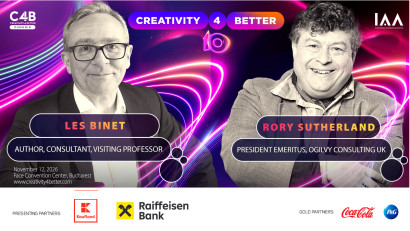
Rory was recently in Bucharest for the Creativity4Better conference, organized by IAA Romania. We sat down with him during one of the conference breaks to talk about the current state of advertising, AI, value, the tyranny of numbers, and what it means to live a good life.
Credits:
Camera Team: Iustin Şurpănelu, Deochi Production | Ovidiu Grămesc, Grizzly Film
Editing & Post-production: Bogdan Jugureanu, Senior Editor & Senior Colorist StudioSet
Sound: Andrei Nechifor, Senior Sound Editor StudioSet
Editorial: Alexandra Bădicioiu Matei, IQads
Filmed at Creativity4Better 2026
This chapter in advertising
We will eventually look back on it as a period of insanity. What has really happened is people who don't fundamentally understand marketing very well have been allowed to seize control of the levers and measures of what makes marketing effective.
As a product of being technologists or management consultants, or to some extent, media people, they've absolutely privileged the quantifiable over the unquantifiable, even when it's completely inappropriate to do so.
The argument I make is: it's very difficult to measure or even attribute something like trust or fame or cultural relevance. And yet, there's this enormous focus on what you might call operational efficiency. And marketing has been allowed to become merely an extension of what you might call, the demand chain as a mirror image of the supply chain, and it's simply something to be optimized at short range.
But the fact remains that it doesn't matter how efficient you are, if nobody's heard about you, if they don't trust you, and if you're not culturally relevant or congruent with the audience you seek to serve, it doesn't matter how efficient you are because no one will buy what you have to offer.
Micro-measures
So what's peculiar is that the upstream discriminators that are really important here, that actually determine macro success, have been subordinated to kind of what you might call micro measures. And you end up with something which I think is quite common. I don't think this is confined to advertising. I think it's actually common in the business world. I think it's also common in the government world, where the treasury now holds a stranglehold over decision-making, for example.
Where we've become micro-clever and macro-dumb.
Everything we do is clever in and of itself at a small scale and makes perfect sense, but it doesn't really scale up to anything that's truly effective.
The Discovery Place
When I first came into business in the 1980s, finance, for instance, and actually also true of sort of HR and other disciplines, but finance was a monetary and advisory function.
It's now, for various reasons, become a prescriptive function. It's not that the finance people encourage you to measure and evaluate what it is you've done. They decide what you can do in the first place. And what that means is if something doesn't make sense to finance, it doesn't matter how good an idea it is, because you're not even allowed to enact it in the first place.
And I think that's deeply problematic because it means the discovery space, the discovery layer, the solution space for businesses, which in the medium to long term, every business isn't really an efficiency mechanism, it's a discovery mechanism. It's a means of discovering through a kind of evolutionary, exploratory process, what customer value is and how you can create more of it from which you can then profit.
How you can create customer value, which you can ultimately translate into profitable revenue.

Communism. Free market
In communism, for example, it was a controlled economy which optimized for the efficient production and distribution of typically manufactured goods. The problem it had wasn't that it was bad at what it did necessarily, although sometimes it was. It was that it never discovered any other forms of value.
For example, the service layer was probably terrible. You did manufacture tractor parts quite effectively, but what you might call customer service in restaurants or whatever was dismal because it only effectively measured, it only valued what it could measure.
One of the great things about free market capitalism when done well and when done reasonably competitively where you don't have market dominance, is that as a by-product of competition, you discover things people value that they never even knew they valued. I mean, we don't even know, I'll be absolutely candid about this. We don't even know ourselves what value is until we experience it.
It's what I call the air fryer phenomenon. Nobody wanted one, but once you have one, you discover it's fantastic.
And that's true of, by the way, dating, house hunting. There are lots of things where actually value is something you can't really define in advance. You can only experience it.
And the good thing about a properly run free market competitive economy is you get to discover sources of value which you never even anticipated and which nobody even asked for in the first place.
If you only allow people effectively to pursue those forms of value which are predefined, you're only exploring a small fraction of the potential space for improvement.
Yeah. It's financialization of everything, quantification of everything, a kind of delusional financial dream that if effectively, if only you have enough data, then all questions answer themselves.
The next chapter
Potentially, and it can go one of two ways. It all depends what question is asked of AI. And I have a little joke I make, which is the two people I don't want to get their hands on artificial intelligence are terrorists and the finance function.
Because if we use AI just to answer the question, how can I do the same with less? Which seems to be the dominant discussion at the moment. How can we make this business more efficient? How can we get rid of headcount? In other words, how can we effectively change nothing but spend less money?
Then I think that's a terrible failure to deploy an innovation to its full extent.
Now, there's a wonderful counter to that, which is IKEA. Now, IKEA isn't a conventional business in that it's not obsessed with its own quarterly reporting. Its corporate governance is quite unusual.
But AI is used in IKEA to replace a lot of the more banal call center functions. And by the way, I'm totally happy with that. I'm very happy to ring a number, for it to be answered immediately, for me to ask, what time does the store in Dartford close? And for it to say, it's open till 7:00 PM this evening, but it's open till 10:00 PM tomorrow. Okay? That would be a really good AI answer. There's no point in having a human to do that. I've already defined the question. It's a very, very simple question. No further conversation may be necessary.
Now, what a lot of companies would've done is they would've just made those people who were previously answering those questions redundant. They didn't do that. They took half of them and retrained them effectively to answer more sophisticated problems. I'm trying to install a BILLY bookcase, what Allen key do I - I'm stereotyping them terribly, but you know what I mean.
They trained up half of the people who are no longer needed to answer those banal questions to answer more sophisticated questions. And then the other half of the people who'd been displaced by AI, they actually upgraded further still, so they became design advisors and design consultants, which is an area where it's more conversational. AI will eventually come for those jobs, I'm sure.
But in the meantime, what you're actually doing is you're using AI to do more with the same rather than using AI to do the same for less. And depending on how you frame the opportunity, whether it's an efficiency, opportunity or a genuinely disruptive innovation opportunity, will determine, AI could cure this problem that I've identified because AI can make probabilistic, multifaceted, multi-dimensional decisions based on complex inputs.
So it can take quantification bias slightly out of the equation by being able to treat words with something like the same value as we might treat numbers.
So you can have a problem which you give to AI, which is a mixture of words and numbers, and it can solve the problem in a way that a more conventional approach wouldn't. In that respect, I'm really, really excited by it. And I think it will allow much more nuanced decision-making if done right.
If, on the other hand, the tech firms basically go, "S**t, we need to make some money from this. What's the easiest sale to the business audience?" The two easiest ways to sell tech are either through fear or through cost savings.
It's much, much more difficult to sell something through potential opportunities. And consequently, what I do worry is that a lot of existing companies will effectively simply use this to downsize the workforce.
What will then happen is they will eventually lose out to more innovative companies, which realize that the proper way to use AI is to do things you've never done before, not to do the same thing cheaper.
What makes for a good life
This is deeply philosophical. One of the areas which really interests me in economics is the sort of work that Morgan Housel does. It's the kind of work which, for example, there's a book called "Happy Money".
I won't answer the question definitively because I don't think there's a definitive answer, and I think, by the way, the correct answer is not a single thing. It's this thing and the opposite of this thing. In other words, have a job, but be present for your family. You know what I mean? That actually it involves the successful resolution of seeming contradictions.
But one thing we grotesquely undervalue, I think, in terms of happiness, which is tarting to be understood much better, is each other. There's a wonderful finding which is people who live in medium-sized towns tend to be happier. And probably the reason for this, by the way, it's quite interesting. One very strong predictor of happiness which emerged from research that one thing that correlated very closely with happiness was how often you bump into people you like unintentionally. So if you think about it, if you live in a really remote place, you see the same people all the time, but you may not like all of them that much.
If you live in a huge city, there may be potentially 50,000 people you'll like, but you won't bump into them very frequently, and it requires advanced arrangements.
"I'll meet you on Saturday night at 7:00". Those communities, student communities will be the same, by the way, where people serendipitously meet all the time without forward planning, just encounter people whose company they enjoy seem to be inordinately happier. And so understanding the value of socialization in happiness.
I would argue, by the way, that we should give generous tax treatment to pubs, cafes, and restaurants because they're part of the health service. They're not just a commercial entity, they're also a social amenity because part of the product in a cafe is the coffee, and part of it is the company. And because they effectively synthesize happiness and wellbeing, I would actually favor generous tax treatment for social spaces.